Other grades of this product :
| Lopinavir Basic information |
| Lopinavir Chemical Properties |
| Melting point | 255.2-260.6 °F (124—127°C) | | Boiling point | 924.1±65.0 °C(Predicted) | | density | 1.163±0.06 g/cm3(Predicted) | | storage temp. | 2-8°C | | solubility | DMSO: soluble20mg/mL, clear | | pka | 13.89±0.46(Predicted) | | form | powder | | color | white to beige | | optical activity | [α]/D -20 to -27°, c = 0.4 in methanol | | Stability: | Hygroscopic | | CAS DataBase Reference | 192725-17-0(CAS DataBase Reference) |
| Lopinavir Usage And Synthesis |
| Description | Lopinavir, the sixth HIV protease inhibitor in the “navir” class, was launched in coformulation
with ritonavir, another HIV protease inhibitor already marketed (Abbott, 1996);
this original formulation was introduced as Kaletra for use in combination with either
nucleoside or non-nucleoside reverse transcriptase inhibitors for the treatment of AIDS in
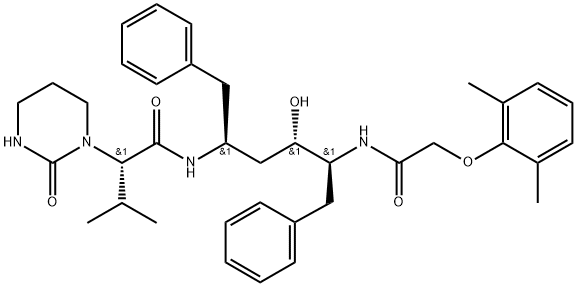
adults and children. Lopinavir is a peptidomimetic compound with a structural core
identical to that of ritonavir, on which terminal groups, particularly a modified valine, were
introduced by peptide coupling procedures. Lopinavir is a potent competitive inhibitor of
HIV-I protease exhibiting high potential against ritonavir-resistant mutations. In several
animal species, pharmacokinetic studies with the lopinavirlritonavir association showed
that the modest properties of lopinavir were significantly improved in presence of ritonavir,
in terms of Cmax and duration of action. Ritonavir inhibits the P450 isoenzyme CYP3A4
and the human liver microsomal metabolism of lopinavir, so strongly amplifying plasma
levels of this latter component. In AIDS patients, the plasma HIV RNA level was
considerably reduced and the CD4+ T-cell counts increased after administration of
lopinavir combined with relatively small doses of ritonavir. Kaletra is intended to be used
jointly with other antiretroviral agents. | | Chemical Properties | Lopinavir is a white to light tan powder. It is freely soluble in methanol and ethanol, soluble in isopropanol and practically insoluble in water. | | Originator | Abbott (US) | | Uses | Lopinavir has been used as a ZMPSTE24 and human immunodeficiency virus protease inhibitor. | | Uses | A selective HIV protease inhibitor. An analogue of Ritonavir. Antiviral. | | Uses | Lopinavir is a potent HIV protease inhibitor with Ki of 1.3 pM | | Definition | ChEBI: Lopinavir is a dicarboxylic acid diamide that is amphetamine is substituted on nitrogen by a (2,6-dimethylphenoxy)acetyl group and on the carbon alpha- to nitrogen by a (1S,3S)-1-hydroxy-3-{[(2S)-3-methyl-2-(2-oxotetrahydropyrimidin-1-yl)butanoyl]amino}-4-phenylbutyl group. An antiretroviral of the protease inhibitor class, it is used against HIV infections as a fixed-dose combination with another protease inhibitor, ritonavir. It has a role as an antiviral drug, a HIV protease inhibitor and an anticoronaviral agent. It is a member of amphetamines and a dicarboxylic acid diamide. | | Indications | Lopinavir is available in the United States only as a
fixed-dose combination with ritonavir (Kaletra). In this
regimen, a low dose of ritonavir is used to inhibit the
rapid inactivation of lopinavir by CYP3A4. | | Manufacturing Process | Manufacturing process for Lopinavir includes these steps as follows: Synthesis of 2,6-dimethylphenoxyacetic
acid; 2,6-
dimethylphenoxyacetyl chloride as an oil; synthesis of (2S,3S,5S)-2-(2,6-dimethylphenoxyacetyl)amino-3-hydroxy-5-(tbutyloxycarbonylamino)-1,6-diphenylhexane; (2S,3S,5S)-2-(2,6-dimethylphenoxyacetyl)amino-3-hydroxy-5-
amino-1,6-diphenylhexane as a white needles; synthesis of N-carbonylbenzyloxy-3-
aminopropanol;synthesis of N-carbonylbenzyloxy-3-aminopropanal solution; N-(N-
(benzyloxycarbonyl-3-amino)-propyl)valine methyl ester, oil state; synthesis of 2S-(1-tetrahydro-pyrimid-2-onyl)-3-
methyl butanoic acid methyl ester;synthesis of 2S-(1-
tetrahydro-pyrimid-2-onyl)-3-methyl butanoic acid methyl ester. The mixture of (2S,3S,5S)-2-(2,6-dimethylphenoxyacetyl)amino-3-hydroxy-5-
amino-1,6-diphenylhexane (100 g, 0.22 mol), 2S-(1-tetrahydro-pyrimid-2-
onyl)-3-methyl butanoic acid methyl ester (44.8 g, 0.22 mol) and 750 ml DMF
was cooled in an ice/water bath. N-Hydroxybenzotriazole (90.9 g, 0.67 mol),
1-ethyl-3-[3-dimethylaminopropyl]carbodiimide (86 g, 0.45 mol) and
triethylamine (62.5 ml, 0.45 mol) were added and the ice bath was removed,
allowing the reaction mixture to stir with warming to room temperature for 5
hours. The mixture was diluted with 1000 ml of IPAC and quenched with 1000
ml of water. The mixture was shaken and separated, the aq. layer was
extracted IPAC, the organics were washed with 10% HCl, solution of NaHCO3
with 100 ml hexanes, then washed 500 ml water, and brine, dried over
MgSO4, filtered and concentrated to provide. (2S,3S,5S)-2-(2,6-
dimethylphenoxyacetyl)amino-3-hydroxy-5-(2S-(1-tetrahydro-pyrimid-2-onyl)-
3-methylbutanoyl)amino-1,6-diphenylhexane as a white foam. | | Brand name | Kaletra | | Therapeutic Function | Antiviral | | Antimicrobial activity | Lopinavir is active against HIV-1 and HIV-2. | | Acquired resistance | Significant resistance to the antiretroviral efficacy of ritonavirbooted
lopinavir occurs as a result of amino acid substitutions
at positions 32, 47 and 82 in the protease region. Protease
inhibitor resistance is uncommon in patients identified with
early failure of combination therapy with ritonavir boostedlopinavir
and nucleotide reverse transcriptase inhibitors. | | General Description | Lopinavir is a protease inhibitor that has been approved foruse in combination with ritonavir for patients with HIV whohave not responded to other treatment modalities. Lopinaviris used in excess over ritonavir. Ritonavir at amounts givenhas no antiretroviral activity, Ritonavir inhibits lopinavir’smetabolism by CYP3A4, causing a higher level of lopinavirin the system. The combination is the first protease inhibitorapproved for patients as young as 6 months of age. | | Biochem/physiol Actions | Lopinavir is an antiviral HIV Protease Inhibitor. Lopinavir has insufficient bioavailability alone, so it is used in therapy in combination with Ritonavir, a HIV protease inhibitor, which inhibits cytochrome P450-3A4 (CYP3A4), a liver enzyme that normally metabolizes protease inhibitors. Lopinavir also has an ability to inhibit ZMPSTE24 (zinc metallopeptidase STE24). | | Pharmacokinetics | Oral absorption: Not known/available
Cmax 400 mg + ritonavir 100 mg twice daily: c. 9.6 mg/L
Cmin 400 mg + ritonavir 100 mg twice daily: c. 5.5 mg/L
Plasma half-life: c. 5–6 h
Volume of distribution: Not known/available
Plasma protein binding: c. 98–99%
Absorption and distribution
The absorption of lopinavir–ritonavir in capsule or liquid form is favorably affected by the presence of food, particularly if high in fat. The CNS penetration is good. It has a semen:plasma ratio of 0.07. It is distributed into breast milk.
Metabolism
Lopinavir is extensively metabolized by the CYP3A4 system, but this is inhibited by ritonavir.
Excretion
Over an 8-day period after single dosing with the combined formulation, around 10% and 83% of the administered dose is recovered in urine and feces, respectively. Less than 3% of the dose is recovered as unchanged drug in urine and 20% in feces. In mild to moderate hepatic impairment, an increase in exposure of approximately 30% is observed, but is probably not clinically relevant. It should be avoided in severe hepatic impairment. | | Clinical Use | Treatment of HIV infection (in combination with ritonavir and other
antiretroviral agents) | | Side effects | The most common adverse events seen in trials of complex antiretroviral
regimens were diarrhea, nausea, headache, fatigue,
vomiting and rash. Ritonavir-boosted lopinavir is associated
with a dyslipidemia profile characteristic of those treated with
other protease inhibitors boosted with 200 mg of ritonavir. | | Drug interactions | Potentially hazardous interactions with other drugs
In combination with ritonavir - see ritonavir interactions.
Anti-arrhythmics: increased risk of ventricular
arrhythmias with flecainide - avoid; possibly
increased lidocaine concentration.
Antibacterials: concentration reduced by rifampicin
- avoid; concentration of delamanid increased;
avoid with telithromycin in severe renal and hepatic
impairment; AUC of bedaquiline increased by 22%,
avoid.
Anticoagulants: avoid with apixaban and
rivaroxaban.
Antidepressants: concentration reduced by St John’s
wort - avoid.
Antiepileptics: concentration possibly reduced by
carbamazepine, fosphenytoin, phenytoin, primidone
and phenobarbital.
Antimalarials: use artemether/lumefantrine with
caution.
Antipsychotics: possibly inhibits metabolism of
aripiprazole - reduce dose of aripiprazole; possibly
increases quetiapine concentration - avoid.
Antivirals: avoid with boceprevir, daclatasvir
and telaprevir; concentration of darunavir and
fosamprenavir reduced - avoid; in combination with
ritonavir concentration of elvitegravir increased -
reduce dose of elvitegravir; concentration reduced
by efavirenz, tipranavir and possibly nevirapine,
consider increasing lopinavir dose; concentration
of paritaprevir increased - avoid; increased risk of
ventricular arrhythmias with saquinavir - avoid;
concentration of tenofovir increased; concentration
of maraviroc increased, consider reducing maraviroc
dose.
Bosentan: concentration of bosentan increased,
consider reducing bosentan dose.
Ciclosporin: may increase concentration of
ciclosporin.
Cytotoxics: reduce dose of ruxolitinib.
Lipid lowering agents: increased risk of myopathy
with atorvastatin; possibly increased risk of
myopathy with rosuvastatin (reduce rosuvastatin
dose) and simvastatin - avoid; avoid with lomitapide.
Orlistat: absorption of lopinavir possibly reduced.
Ranolazine: possibly increases ranolazine
concentration - avoid.
Sirolimus: may increase concentration of sirolimus.
Tacrolimus: may increase concentration of
tacrolimus. | | Metabolism | Lopinavir is extensively metabolised, mainly by oxidation
by cytochrome P450 isoenzyme CYP3A4; 13 metabolites
have been identified with some, such as 4-oxylopinavir
and 4-hydroxylopinavir, having antiviral activity.
Lopinavir is mainly excreted in faeces and to a smaller
extent in the urine; unchanged lopinavir accounts for
about 2.2% of a dose excreted in the urine and 19.8%
in the faeces. After multiple dosing, less than 3% of the
absorbed lopinavir dose is excreted unchanged in the
urine |
| Lopinavir Preparation Products And Raw materials |
|


 日本语
日本语 한국어
한국어 Français
 Deutsch
 España
 Türkiye