Other grades of this product :
| Leupeptin Basic information |
| Leupeptin Chemical Properties |
| alpha | -76 º (c=1, water) | | storage temp. | -20°C | | solubility | H2O: 10 mM Solutions are stable for a week at 4 °C. Stock solutions are stable up to 6 months at −20°C. | | form | Powder | | color | White to Off-white | | Water Solubility | soluble | | Stability: | Stable for 1 year from date of purchase as supplied Solutions in distilled water, ethanol or methanol may be stored at -20°C for up to 3 months. | | InChIKey | CIPMKIHUGVGQTG-VFFZMTJFSA-N |
| Leupeptin Usage And Synthesis |
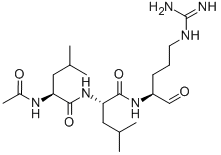
| Description | Leupeptin hemisulfate (103476-89-7) is a reversible inhibitor of trypsin-like proteases and cysteine proteases. Inhibits trypsin, plasmin, papain and cathepsin B, H and L.1-3?Blocks various apoptotic pathways in T cells.4?Commonly used in cell lysis buffers to protect proteins from degradation. Typical working concentration is 1μM (0.5 μg/ml). | | Chemical Properties | White to off-white lyophilized powder | | Uses | Reversible protease inhibitor, which inhibits cathepsin B, calpain and trypsinPharmaceutical composition containing leupeptin hemisulfate is used as an anti-malarial agent. It is employed in the treatment of noise-induced hearing loss. It also protects the heart from myocardial stunning. Further, it is used to inhibit serine, cysteine proteases, plasmin, trypsin, papain, kallikrein and cathepsin B. | | Uses | Leupeptin as well as other protease inhibitors like antipain, chymostatin, pepstatin, and phosphoramidon are useful for the protection of proteins during their isolation from tissues or membranes. Leupeptin can be removed from the reaction by dialysis.Note: To check other protease inhibitors, try our Protease Inhibitor Set including Antipain Dihydrochloride, Aprotinin, Bestatin, Chymostatin, E-64, EDTA-Na2, Leupeptin, Pefabloc SC, Pepstatin, and Phosphoramidon. | | Uses | Leupeptin has been used as a protease inhibitor: in ice-cold lysis buffer to harvest cells for western immunoblotting and immunoprecipitation,in chromatin immunoprecipitation (ChIP) lysis buffer for the isolation of fragmented chromatin samples in lysis buffer I to lyse the cells for tandem affinity purification (TAP) | | Definition | ChEBI: A peptide sulfate salt obtained by combining leupeptin with 0.5 molar equivalents of sulfuric acid. | | General Description | Leupeptin, or N-acetyl-L-leucyl-L-leucyl-L-argininal, is a naturally occurring tripeptide that acts particularly as a serine protease inhibitor and as a cysteine protease inhibitor. Its mechanism of action involves structurally similar covalent binding reactions:- In the active site of serine proteases, leupeptin forms a covalent hemiacetal adduct between the aldehyde group of leupeptin and the hydroxyl group of a serine residue in the enzyme active site.
- In the active site of cysteine proteases, the electrophilic (aldehyde) carbon of leupeptin forms a comparable bond with the sulfur atom of a cysteine residue in the enzyme active site.
| | Biochem/physiol Actions | Inhibitor of serine and cysteine proteases. Inhibits plasmin, trypsin, papain, calpain, and cathepsin B. Does not inhibit pepsin, cathepsins A and D, thrombin, or α-chymotrypsin. Effective concentration 10-100 μM. There have been numerous studies using leupeptin to protect against hearing loss caused by acoustic overstimulation or the ototoxic antibiotic gentamicin. (Loss of cochlear hair cells is believed to be mediated by calpain.) | | References | 1) Aoyagi?et al.?(1969),?Leupeptins, new protease inhibitors from Actinomycetes; J. Antibiot.,?22?283
2) Barrett?et al.?(1981),?Cathepsin B, Cathepsin H and Cathepsin L; Methods Enzymol., Pt C,?80?535
3) Knight?et al. (1980),?Human cathepsin B. Application of the substrate N-benzyloxycarbonyl-L-arginyl-L-arginine 2-naphthylamide to a study of the inhibition by leupeptin; Biochem. J.,?189?447
4) Sarin?et al. (1995),?A protease-dependent TCR-induced death pathway in mature lymphocytes; J. Immunol.,?154?5806 |
| Leupeptin Preparation Products And Raw materials |
|


 日本语
日本语 한국어
한국어 Français
 Deutsch
 España
 Türkiye