Other grades of this product :
| Poly(L-lysine hydrobromide) Basic information |
| Poly(L-lysine hydrobromide) Chemical Properties |
| storage temp. | 2-8°C | | form | lyophilized powder | | Stability: | Stable. Incompatible with strong acids, strong bases. |
| Poly(L-lysine hydrobromide) Usage And Synthesis |
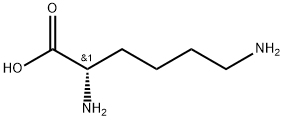
| Chemical Properties | white powder | | Uses | Poly-L-lysine polymers can be used in promoting cell adhesion to solid substrates, conjugation to methotrexate for increased drug transport, microencapsulation of islets, cell microencapsulation technology, microarray glass slide coating, and chromosomal preparations. It has also been used as a transfection agent for efficient labeling and to facilitate endocytosis. Lower molecular weight poly-L-lysine (30,000-70,000) is less viscuous in solution, but higher molecular weight versions provide more attachment sites per molecule. | | Uses | - Poly-L-lysine coated glass coverslips have been used for mounting samples for scanning electron microscopy.
- Poly-L-lysine coated wells were used for trapping of PC-12 cells on electrodes.
- Poly-L-lysine-coated borosilicate glass slides were used for the seeding of viral vector-transduced cells.
| | Uses | Recommended as a cell culture substratum when using 0.5 ml of a 0.1 mg/ml solution to coat 25 cm2. Optimal conditions for attachment must be determined for each cell line and application. | | Definition | ChEBI: The hydrobromide salt of poly(L-lysine). | | General Description | Poly-L-lysine hydrobromide is a nonspecific attachment factor in promoting cell adhesion to the substratum. | | Biochem/physiol Actions | Poly-L-lysine is a nonspecific attachment factor for cells useful in promoting cell adhesion to solid substrates by enhancing electrostatic interaction between negatively charged ions of the cell membrane and the culture surface. When it is absorbed to the cell culture surface, poly-L-lysine functions to increase the number of positively charged sites available for cell binding. With cells that can digest poly-L-lysine, poly-D-lysine should be used as the attachment factor. |
| Poly(L-lysine hydrobromide) Preparation Products And Raw materials |
|


 日本语
日本语 한국어
한국어 Français
 Deutsch
 España
 Türkiye