Other grades of this product :
| CALYCOSIN Chemical Properties |
| Melting point | 245~247℃ | | Boiling point | 536.8±50.0 °C(Predicted) | | density | 1.420±0.06 g/cm3(Predicted) | | storage temp. | Sealed in dry,2-8°C | | solubility | methanol: soluble1mg/mL, clear, colorless | | pka | 6.94±0.20(Predicted) | | form | powder | | color | white to light yellow | | InChIKey | ZZAJQOPSWWVMBI-UHFFFAOYSA-N |
| CALYCOSIN Usage And Synthesis |
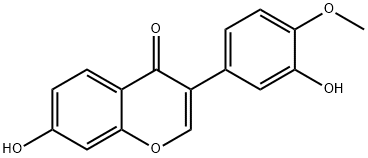
| Definition | Calycosin is an O-methylated isoflavone. It can be isolated from Astragalus membranaceus Bge. var. mongholicus and Trifolium pratense L. Calycosin is a member of the class of 7-hydroxyisoflavones that is 7-hydroxyisoflavone which is substituted by an additional hydroxy group at the 3' position and a methoxy group at the 4' position. It has a role as a metabolite and an antioxidant. It is a member of 7-hydroxyisoflavones and a member of 4'-methoxyisoflavones. It derives from an isoflavone. It is a conjugate acid of a calycosin(1-).
| | Pharmaceutical Properties | The potential pharmaceutical properties of calycosin in the treatment of tumors, inflammation, stroke, and cardiovascular diseases have gained increasing attention in the recent years. The literature survey showed that calycosin exhibits promising effects for the treatment of several diseases and that these effects may be due to its isoflavonoid and phytoestrogenic properties. The effects of calycosin most likely result from its interaction with the ER receptors on the cell membrane and the modulation of the MAPK signaling pathway.
Through its effect on this pathway, calycosin can regulate several cell activities, such as apoptosis and angiogenesis, which enables its therapeutic functions.
|
| CALYCOSIN Preparation Products And Raw materials |
|


 日本语
日本语 한국어
한국어 Français
 Deutsch
 España
 Türkiye