Other grades of this product :
| (R)-Lactate Basic information |
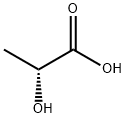
| Product Name: | (R)-Lactate | | Synonyms: | (r)-lactate;(R)-2-HYDROXYPROPIONIC ACID;D-MILK ACID;D(-)LACTIC ACID;D-LACTIC ACID;D-2-HYDROXYPROPANOIC ACID;(R)-lactic acid;(R)-2-Hydroxypropanoic acid | | CAS: | 10326-41-7 | | MF: | C3H6O3 | | MW: | 90.08 | | EINECS: | 233-713-2 | | Product Categories: | bc0001 | | Mol File: | 10326-41-7.mol |
| (R)-Lactate Chemical Properties |
| Melting point | 52.8° | | alpha | 54621.5 -2.6° (c = 8) | | Boiling point | 227.6±0.0 °C(Predicted) | | density | 1.276±0.06 g/cm3(Predicted) | | vapor pressure | 3.8Pa at 25℃ | | FEMA | 2611 | LACTIC ACID | | refractive index | 1.4280 to 1.4320 | | storage temp. | -20°C | | solubility | H2O: 0.1 g/mL, clear, colorless | | form | Low Melting Solid | | pka | pK = 3.83(at 25℃) | | color | White to Off-white | | Water Solubility | Soluble in water (50mg/ml) | | Merck | 14,5335 | | JECFA Number | 930 | | BRN | 1720252 | | Stability: | Hygroscopic | | InChIKey | JVTAAEKCZFNVCJ-UWTATZPHSA-N | | LogP | -0.54 at 20℃ | | CAS DataBase Reference | 10326-41-7(CAS DataBase Reference) | | EPA Substance Registry System | Propanoic acid, 2-hydroxy-, (2R)- (10326-41-7) |
| Hazard Codes | Xi | | Risk Statements | 38-41 | | Safety Statements | 26-39 | | RIDADR | UN 3265 8/PG III | | WGK Germany | 3 | | F | 3-10 | | TSCA | Yes | | HazardClass | 8 | | PackingGroup | III | | HS Code | 2918110000 |
| (R)-Lactate Usage And Synthesis |
| Uses | D-(-)-Lactic acid is a useful biochemical for proteomics research. It is also used in the production of chiral drug and in the chemical synthesis. Lactic acid is used as a reagent in organic synthesis (in the manufacture of adhesives). It is used in the leather, textile, and tanning industries. It may be used as a plasticizer, a catalyst, or an acidifying agent. Lactic acid has even been used as a flavoring agent in the manufacture of tobacco products. | | Flammability and Explosibility | Notclassified | | Biochem/physiol Actions | In animals, lactic acid is a metabolic compound produced by proliferating cells and during anaerobic conditions such as strenuous exercise. Lactic acid can be oxidized back to pyruvate or converted to glucose via gluconeogenesis. Lactic acid is preferentially metabolized by neurons in several mammal species and during early brain development. D-lactate was utilized four times more slowly than L-lactate, but both isomers are absorbed at the same rate from the intestine. |
| (R)-Lactate Preparation Products And Raw materials |
|


 日本语
日本语 한국어
한국어 Français
 Deutsch
 España
 Türkiye