| Chemical Properties | white crystalline powder |
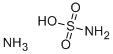
| Chemical Properties | Ammonium sulfamate is a white to yellow
crystalline solid. |
| Uses | In the manufacture of fire-retardant compositions, for flameproofing textiles and paper products; in the manufacture of weed killing compositions; in electroplating solutions; for the generation of nitrous oxide gas. |
| Uses | Ammonium sulfamate (AMS) is an inorganic herbicide used for control of woody plants and herbaceous perennials. |
| Uses | Manufacture of weed-killing compounds
and fire-retardant compositions |
| General Description | Ammonium sulfamate is a white crystalline solid. Ammonium sulfamate is soluble in water. The primary hazard is the threat to the environment. Immediate steps should be taken to limit its spread to the environment. Ammonium sulfamate is used to flameproof fabrics and papers, in weed or brush killing products, and for other uses. |
| Air & Water Reactions | Water soluble. Hot water [Note: Elevated temperatures cause a highly exothermic reaction with water (in the presence of acid)] . |
| Reactivity Profile | Ammonium sulfamate is incompatible with the following: Acids, hot water [Note: Elevated temperatures cause a highly exothermic reaction with water (in the presence of acid).] . |
| Hazard | Hot acid solutions when enclosed may
explode.
|
| Health Hazard | Inhalation causes irritation of nose and throat. Ingestion causes gastrointestinal disturbances. Dust irritates eyes. |
| Fire Hazard | Special Hazards of Combustion Products: Toxic oxides of nitrogen may form in fires. |
| Safety Profile | Moderately toxic by
ingestion and intraperitoneal routes.
Somewhat explosive when heated or by
spontaneous chemical reaction in a hot acid
solution. A powerful oxidizer. When heated
to decomposition it emits very toxic fumes
of NH3, NOx, and SOx. See also
SULFONATES and SULFAMIC ACID. |
| Potential Exposure | Ammonium sulfamate is used as a
herbicide and in compositions for retarding flame in textiles
and paper products; a softener for paper, cotton textiles. |
| Carcinogenicity | The oral LD50 values were 3900 mg/kg for
rats and 5760 mg/kg for mice. |
| Shipping | UN3077 Environmentally hazardous substances,
solid, n.o.s., Hazard class: 9; Labels: 9-Miscellaneous hazardous
material, Technical Name Required. |
| Purification Methods | Crystallise it from water at room temperature (1mL/g) by adding EtOH and cooling. [Sisler & Audrieth Inorg Synth II 180 1946.] |
| Incompatibilities | Strong oxidizers, potassium, potassium
chlorate, sodium nitrite, metal chlorates, and hot acid solutions.
Elevated temperatures cause a highly exothermic
reaction with water. |
| Waste Disposal | Consult with environmental
regulatory agencies for guidance on acceptable disposal
practices. Generators of waste containing this contaminant
(≥100 kg/mo) must conform with EPA regulations governing
storage, transportation, treatment, and waste disposal.
Dilute with water, make neutral with acid or base and flush
into sewer with more water. |


 日本语
日本语 한국어
한국어 Français
 Deutsch
 España
 Türkiye