Other grades of this product :
| 4-(2-Aminoethyl)morpholine Basic information |
| 4-(2-Aminoethyl)morpholine Chemical Properties |
| Melting point | 24 °C | | Boiling point | 205 °C(lit.) | | density | 0.992 g/mL at 25 °C(lit.) | | refractive index | n20/D 1.476(lit.) | | Fp | 347 °F | | storage temp. | Keep in dark place,Sealed in dry,Room Temperature | | form | Liquid After Melting | | pka | pK1: 4.06(+2);pK2: 9.15(+1) (25°C) | | color | Clear colorless to pale yellow | | Water Solubility | soluble | | Sensitive | Air Sensitive | | BRN | 104378 | | InChIKey | RWIVICVCHVMHMU-UHFFFAOYSA-N | | CAS DataBase Reference | 2038-03-1(CAS DataBase Reference) | | NIST Chemistry Reference | 4-Morpholineethanamine(2038-03-1) | | EPA Substance Registry System | 4-Morpholineethanamine (2038-03-1) |
| 4-(2-Aminoethyl)morpholine Usage And Synthesis |
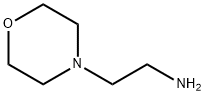
| Chemical Properties | clear colorless to pale yellow liq. after melting | | Uses | 4-(2-Aminoethyl)morpholine is used as a ligand and reacts with nickel(II) nitrite to form trans-bis[4-(2-aminoethyl)morpholine]dinitronickel(II). | | Uses | 4-(2-Aminoethyl)morpholine is widely used in biomedical applications as this moiety serves as an important lysosome-targeting group. Some of its applications include:- Synthesis of the lysosome-targetable fluorescent probe for hydrogen sulfide imaging in living cells.
- Synthesis of 1,8-naphthalimide conjugated Troger′s bases as deoxyribonucleic acid (DNA) targeting fluorescent probe.
- Synthesis of intramolecular charge transfer-photoinduced electron transfer-fluorescence resonance energy transfer (ICT-PET-FRET) fluorescent probe for monitoring pH changes in living cells.
- It is also used as a precursor to synthesize a variety of antimicrobial agents.
| | Synthesis Reference(s) | Journal of Medicinal Chemistry, 34, p. 1805, 1991 DOI: 10.1021/jm00110a008 |
| 4-(2-Aminoethyl)morpholine Preparation Products And Raw materials |
|


 日本语
日本语 한국어
한국어 Français
 Deutsch
 España
 Türkiye