Other grades of this product :
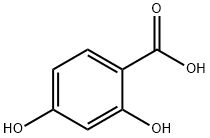
| Product Name: | 2,4-Dihydroxybenzoic acid | | Synonyms: | 2,4-Dihydrox;Sodium aminosalicylate Impurity 3;2,4-Dihydroxybenzoesure;p-hydroxysalicylicacid;Resorcylic acid, beta;-Resorcylicacid;2,4-DIHYDROXYBENZOIC ACID / BETA-RESORCYLIC ACID;SS-RESORCYLIC ACID | | CAS: | 89-86-1 | | MF: | C7H6O4 | | MW: | 154.12 | | EINECS: | 201-946-9 | | Product Categories: | Pyridines ,Halogenated Heterocycles ,Heterocyclic Acids;sy;Building Blocks;C7;Carbonyl Compounds;Carboxylic Acids;Intermediates of Dyes and Pigments;FINE Chemical & INTERMEDIATES;Aromatic Carboxylic Acids, Amides, Anilides, Anhydrides & Salts;BenzoicAcidDerivative;Organic acids;Chemical Synthesis;Organic Building Blocks | | Mol File: | 89-86-1.mol |
| 2,4-Dihydroxybenzoic acid Chemical Properties |
| Melting point | 208-211 °C (dec.) (lit.) | | Boiling point | 237.46°C (rough estimate) | | density | 1.3725 (rough estimate) | | vapor pressure | 0Pa at 25℃ | | refractive index | 1.6710 (estimate) | | FEMA | 3798 | 2,4-DIHYDROXYBENZOIC ACID | | Fp | 200 °C | | storage temp. | Inert atmosphere,Room Temperature | | solubility | 8g/l | | form | Crystalline Powder | | pka | 3.11, 8.55, 14.0(at 25℃) | | color | Cream to slightly beige or pink | | Water Solubility | 8 g/L (20 ºC) | | Merck | 14,8157 | | JECFA Number | 908 | | BRN | 1946213 | | InChIKey | UIAFKZKHHVMJGS-UHFFFAOYSA-N | | LogP | 0.98 at 23℃ and pH3.5 | | CAS DataBase Reference | 89-86-1(CAS DataBase Reference) | | NIST Chemistry Reference | 2,4-Dihydroxybenzoic acid(89-86-1) | | EPA Substance Registry System | 2,4-Resorcylic acid (89-86-1) |
| Hazard Codes | Xi | | Risk Statements | 36/37/38 | | Safety Statements | 26-36-37/39 | | WGK Germany | 1 | | RTECS | VH3708050 | | TSCA | Yes | | HS Code | 29182990 |
| 2,4-Dihydroxybenzoic acid Usage And Synthesis |
| Uses | 2,4-Dihydroxybenzoic acid is a useful synthetic intermediate. An organic building block for plastics and rubber products. | | Toxicity | GRAS (FEMA). | | Usage limits | FEMA (mg/kg): cold drink: 450; Meat, dairy, processed vegetables, 100; fudge, gel, pudding, snack food, beverages, breakfast cereals, fats, cheeses, poultry products, fish, spices, sweet sauce, dairy products, meat soup, fruit ice Egg products, jams, jelly, rehydrated vegetables, 500; soup: 250; jelly sugar: 3333; instant coffee and tea: 12.5; sugar substitute: 12500; seasoning spices: 25000. | | Chemical properties | It appears as white needle crystal. It will contain crystal water upon crystallization from the water. It appears as an anhydride at 100 ℃. Melting point 218-219 ° C (it has a melting point of 213 ° C upon thermal shock). Soluble in hot water, ethanol, ether. Cooking in water, acid or salt solution will remove carbon dioxide. It exhibits red color upon reaction with ferric chloride. | | Application |
- The product has the chemical properties of both resorcinol and salicylic acid. It can be used in chemical reagents for colorimetric determination of iron, titanium and other elements; for organic synthesis, it is mainly used for dyes and pharmaceutical intermediates. 2, 4-dihydroxybenzoic acid is a major raw material during the production of acidic medicated pink 3BM, which consumes 157 kg per ton of dye (by 100%).
- Used as a dye intermediate, medicine and reagents
- Used as dyes, pharmaceuticals, pesticide intermediates
| | Preparation | It is derived from the hydroxylation of resorcinol. | | Chemical Properties | cream to slightly beige or pink crystalline powder | | Chemical Properties | Dihydroxybenzoic acid is a colorless solid and is used as a flavor modifier. | | Occurrence | Reported present in avocados, beer, red wine, roast coffee, sherry, smoked sausage and white wine | | Uses | 2,4-Dihydroxybenzoic acid is used in Intermediates, Plasticizers, Plastic and Rubber Products, a organic building block. | | Uses | Intermediate for dyestuffs and drugs; spot test reagent for iron. | | Preparation | Prepared from resorcinol and potassium bicarbonate in glycerol or water by heating and passing carbon dioxide through
the mixture. | | Purification Methods | Crystallise the acid from water. [Beilstein 10 IV 1420.] |
| 2,4-Dihydroxybenzoic acid Preparation Products And Raw materials |
| Raw materials | Sodium bicarbonate-->Resorcinol-->2,3-Dihydroxybenzoic acid-->2,5-Dihydroxybenzoic acid | | Preparation Products | 2,6-Dihydroxybenzoic acid-->4-Methoxysalicylic acid-->2,4-Dimethoxybenzoic acid-->Methyl 2,5-dihydroxybenzoate-->Methyl 2,4-dihydroxybenzoate-->3,6-DIHYDROXYXANTHONE-->3,6-Dimethoxyxanthone-->METHYL 2,4-DIMETHOXYBENZOATE-->2,4,5-TRIHYDROXYBENZOIC ACID-->2,4-Dihydroxybenzamide-->KUWANONC-->2-BROMO-5-METHOXYPHENOL-->Protocatechuic acid-->Mordant Red 15 |
|


 日本语
日本语 한국어
한국어 Français
 Deutsch
 España
 Türkiye