Other grades of this product :
| 3-Dimethylaminopropylamine Basic information |
| 3-Dimethylaminopropylamine Chemical Properties |
| Melting point | -60 °C | | Boiling point | 133 °C(lit.) | | density | 0.812 g/mL at 25 °C(lit.) | | vapor density | 3.6 (vs air) | | vapor pressure | 5 mm Hg ( 20 °C) | | refractive index | n20/D 1.435(lit.) | | Fp | 90 °F | | storage temp. | Store below +30°C. | | form | Liquid | | pka | 10.13±0.10(Predicted) | | color | Clear | | PH | 12.7 (100g/l, H2O, 20℃) | | explosive limit | 2.3-12.35%(V) | | Water Solubility | SOLUBLE | | FreezingPoint | -70℃ | | Sensitive | Air Sensitive | | BRN | 605293 | | InChIKey | IUNMPGNGSSIWFP-UHFFFAOYSA-N | | LogP | -0.352 at 25℃ | | CAS DataBase Reference | 109-55-7(CAS DataBase Reference) | | NIST Chemistry Reference | 1,3-Propanediamine, N,N-dimethyl-(109-55-7) | | EPA Substance Registry System | 3-(Dimethylamino)propylamine (109-55-7) |
| 3-Dimethylaminopropylamine Usage And Synthesis |
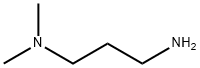
| Description | Dimethylaminopropylamine is an aliphatic amine
present in amphoteric surfactants such as liquid soaps
and shampoos. It is present as an impurity responsible
for allergy from cocamidopropylbetaine. It is structurally
similar to diethylaminopropylamine. It is also used
as a curing agent for epoxy res ins and as an organic
intermediate in chemical syntheses (ion exchangers,
additives for flocculants, cosmetics and fuel additives,
dyes and pesticides).
| | Chemical Properties | clear liquid. soluble in water and organic solvents. | | Uses | N,N-Dimethyl-1,3-propylenediamine is a useful catalyst for Knoevenagel condensation. It is also a useful hardening agent for expoxy resin. | | Uses | Useful for cleavage of N-alkylphthalimide derivatives to give primary amines, as an alternative to methyl hydrazine. DMAPA is also used directly as a hardener in epoxy resins in the plastics industry, as a cross linking agent for cellulose fibers in the paper industry and as an anti-shriking agent for leather. It is used as an intermediate in the production of binding agents, ion-exchange materials, flocculating agents (water treatment), cosmetic agents, washing and cleaning agents (betaines), additive for petrol and other fuels, polyurethane fibers and lubricants, dyes, agrochemicals, agents used in the photographic and textile industries. | | Uses | 3-(Dimethylamino)propylamine is an intermediate substance in the synthesis of alkylamidopropyldimethylamines/alkylamidobetaines; found as an impurity in
cosmetic surfactants present in e.g. shampoos; hardener of epoxy resins; additive in fue!, dyes, pesticides and binding agents; in the
production of ion-exchangers. | | General Description | Dimethylaminopropylamine is a colorless liquid. (NTP, 1992) | | Air & Water Reactions | Highly flammable. Temperature sensitive and possibly sensitive to air. Water soluble. | | Reactivity Profile | 3-Dimethylaminopropylamine neutralizes acids in exothermic reactions to form salts plus water. May be incompatible with isocyanates, halogenated organics, peroxides, phenols (acidic), epoxides, anhydrides, and acid halides. Flammable gaseous hydrogen may be generated in combination with strong reducing agents, such as hydrides. | | Fire Hazard | 3-Dimethylaminopropylamine is flammable. | | Safety Profile | Moderately toxic by ingestion and skin contact. A skin and eye irritant. Very flammable when exposed to heat, flame, or oxidmers. Reaction with 1,2dichloroethane produces explosive acetylene gas. This and other amines igmte on contact with cellulose nitrate of hgh surface area. To fight fire, use alcohol foam, CO2, dry chemical. When heated to decomposition it emits toxic fumes of NO,. See also AMINES |
| 3-Dimethylaminopropylamine Preparation Products And Raw materials |
| Raw materials | Hydrogen-->Dimethylamine-->Dimethylaminopropionitrile-->HYDROGENATION CATALYST-->1-Propanol, 3-amino-,1-(hydrogen sulfate)-->1H-Isoindole-1,3(2H)-dione, 2-[3-(dimethylamino)propyl]--->3-(DIMETHYLAMINO)ACRYLONITRILE-->N,N-Dimethylaminopropyl acrylamide-->N-METHYL-1,3-PROPANEDIAMINE-->N,N'-Dimethyl-1,3-propanediamine-->ALPHA-DIMETHYLAMINOPROPIONITRILE-->3,3'-IMINOBIS(N,N-DIMETHYLPROPYLAMINE) | | Preparation Products | 1-(3-DIMETHYLAMINOPROPYL)-3-ETHYLCARBODIIMIDE METHIODIDE-->1-(3-Dimethylaminopropyl)-3-ethylcarbodiimide-->N-[3-(dimethylamino)propyl]myristamide-->SEC-BUTYL ETHER |
|


 日本语
日本语 한국어
한국어 Français
 Deutsch
 España
 Türkiye