Other grades of this product :
| Triphenylsilane Basic information |
| Triphenylsilane Chemical Properties |
| Melting point | 43-45 °C (lit.) | | Boiling point | 152 °C/2 mmHg (lit.) | | refractive index | 1.6160 | | Fp | 169 °F | | storage temp. | Inert atmosphere,2-8°C | | solubility | sol most organic solvents. | | form | Powder | | color | off-white | | Water Solubility | REACTS | | Sensitive | Air Sensitive | | Hydrolytic Sensitivity | 3: reacts with aqueous base | | BRN | 978182 | | InChIKey | AKQNYQDSIDKVJZ-UHFFFAOYSA-N | | CAS DataBase Reference | 789-25-3(CAS DataBase Reference) | | NIST Chemistry Reference | Silane, triphenyl-(789-25-3) | | EPA Substance Registry System | Silane, triphenyl- (789-25-3) |
| Hazard Codes | Xi | | Risk Statements | 36/37/38 | | Safety Statements | 26-37 | | WGK Germany | 1 | | TSCA | Yes | | HS Code | 29310095 |
| Triphenylsilane Usage And Synthesis |
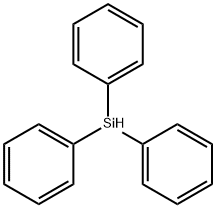
| Chemical Properties | Triphenylsilane is Off-white solid
| | Physical properties | mp 47 °C; bp 152 °C/2 mmHg. | | Uses | Triphenylsilane acts as a reactant or reagent for catalytic hydrogen deuterium exchange reactions of silanes, to be oxidized by carbon nanotube-gold nanohybrids, for hydrolysis by ruthenium complexes, for hydrosilylation to produce enolsilanes, for synthesis of bromosilanes, for ozone oxidation of silyl-alkenes for synthesis of α-O-silylated acyloin derivatives. It is used to synthesize hydrido silyl and bis(silyl) bis(imidazolinylidene) nickel complexes. | | Uses | Reactant or reagent:• ;For catalytic hydrogen deuterium exchange reactions of silanes1• ;To be oxidized by carbon nanotube-gold nanohybrids2• ;For hydrolysis by ruthenium complexes3• ;For hydrosilylation to produce enolsilanes4• ;For synthesis of bromosilanes5• ;For ozone oxidation of silyl-alkenes for synthesis of α-O-silylated acyloin derivatives6• ;Used to synthesize hydrido silyl and bis(silyl) bis(imidazolinylidene) nickel complexes7 | | Uses | Triphenylsilane is reducing agent for esters, xanthates, and polychloroalkanes;
protecting group for alcohols. It takes part in the reactions of Deoxygenations, Hydrosilylations, Lewis Acid-assisted Hydrosilylations, Heteroatom Reductions, Multiple Bond Reductions, Alkene Hydrogenations, Silylations, etc. | | Application | More effective radical-based reagent for reduction of
organic halides than the trialkylsilanes. Compares
well with tri-n-butyltin hydride in reduction of enones to
ketones. Shows good selectivity in the reduction of cyclic
hemiacetals. Converts O-acetyl furanoses and pyranoses
to deoxy sugars. | | Purification Methods | Purify it by recrystallisation from MeOH. [Gilman & Zuech J Am Chem Soc 81 5925 1959, Westermark Acta Chem Scand 9 947 1955, IR: Kaplan J Am Chem Soc 76 5880 1954, Beilstein 16 II 605, 16 III 1199, 16 IV 1369.] |
| Triphenylsilane Preparation Products And Raw materials |
|


 日本语
日本语 한국어
한국어 Français
 Deutsch
 España
 Türkiye