Other grades of this product :
| EUGENOL ACETATE Basic information |
| EUGENOL ACETATE Chemical Properties |
| Hazard Codes | Xn | | Risk Statements | 22-38 | | Safety Statements | 36 | | WGK Germany | 2 | | RTECS | SJ4550000 | | HS Code | 29147000 | | toxicity | The acute oral LD50 value in rats was reported as 1.67 g/kg (Jenner, Hagan, Taylor, Cook & Fitzhugh, 1964) and as 2.6 g/kg (2.3-2.9 g/kg) (Moreno, 1972b). The acute dermal LD50 value in rabbits exceeded 5 g/kg (Moreno, 1972a). |
| EUGENOL ACETATE Usage And Synthesis |
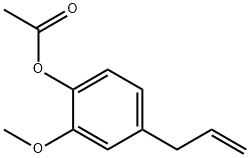
| Chemical Properties | liquid | | Chemical Properties | Eugenol Acetate occurs in clove
oil, together with eugenol. It is a crystalline solid (mp 29°C) or yellowish liquid
with a slightly fruity, clove odor. Eugenol acetate is prepared by acetylation of
eugenol with acetic anhydride and is used in floral compositions to accentuate
floral, spicy characters. | | Chemical Properties | Eugenyl acetate has a characteristic odor reminiscent of clove oil, with a burning, aromatic favor. | | Occurrence | Reported found in the essential oils of Laurus nobilis, clove buds and leaves, cassia leaf and cinnamon leaf, root and bark | | Uses | Eugenol Acetate is a constituent of Clove oil, an essential oil from the clove plant, Syzygium aromaticum. Clove oil is a natural analgaesic and antiseptic used primarily in dentistry for its main ingredient Eugenol. Clove oil can also be purchased in pharmacies over the counter, as a home remedy for dental pain relief, mainly toothache; it is also often found in the aromatherapy section of health food stores. | | Preparation | By direct acetylation of eugenol using acetic anhydride. | | Flammability and Explosibility | Notclassified | | Safety Profile | Moderately toxic by
ingestion. A skin irritant. Combustible
liquid. When heated to decomposition it
emits acrid smoke and irritating fumes. See
also EUGENOL, ALLYL COMPOUNDS,
and ESTERS. |
| EUGENOL ACETATE Preparation Products And Raw materials |
|


 日本语
日本语 한국어
한국어 Français
 Deutsch
 España
 Türkiye