Other grades of this product :
| GSK1349572 sodiuM salt Basic information |
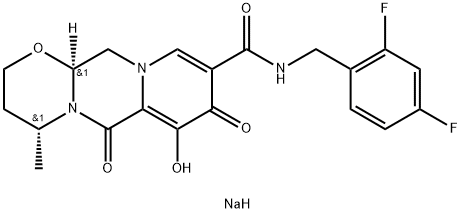
| Product Name: | GSK1349572 sodiuM salt | | Synonyms: | GSK1349572 sodiuM salt;DOLUTEGRAVIR SODIUM;GSK 1349572A;Dolutegravir sodiuM salt;Dolutegravir SodiuM ( API);Sodium (4R,12aS)-9-((2,4-difluorobenzyl)carbamoyl)-4-methyl-6,8-dioxo-3,4,6,8,12,12a-hexahydro-2H-pyrido[1',2':4,5]pyrazino[2,1-b][1,3]oxazin-7-olate;Dolutegravir sodium(GSK1349572);(4R,12aS)-N-[(2,4-Difluorophenyl)methyl]-3,4,6,8,12,12a-hexahydro-7-hydroxy-4-methyl-6,8-dioxo-2H-pyrido[1',2':4,5]pyrazino[2,1-b][1,3]oxazine-9-carboxamide sodium salt (1:1) | | CAS: | 1051375-19-9 | | MF: | C20H20F2N3NaO5 | | MW: | 443.38 | | EINECS: | 812-620-6 | | Product Categories: | Inhibitors;HIV-1 integrase inhibitor | | Mol File: | 1051375-19-9.mol |
| GSK1349572 sodiuM salt Chemical Properties |
| Melting point | >300oC | | storage temp. | Hygroscopic, -20°C Freezer, Under inert atmosphere | | solubility | DMSO (Slightly, Heated), Methanol (Slightly, Heated) | | form | Solid | | color | White to Green | | Stability: | Hygroscopic |
| GSK1349572 sodiuM salt Usage And Synthesis |
| Description | Dolutegravir sodium (Tivicay), developed and marketed by
GlaxoSmithKline, was approved by the FDA in August 2013 as a
novel integrase inhibitor for the treatment of HIV infection.
Dolutegravir was fast-tracked by the FDA in February 2012, and
joins an important class of drugs known as Integrase Strand
Transfer inhibitors (INSTi’s). INSTi’s are characterized by their
two-metal-chelating scaffolds, which are known to chelate Mg2+
cofactors in the enzyme active site, l interrupting function of
HIV-1 integrase, which is essential for replication of viral DNA into
host chromatin.Other drugs in this class, raltegravir and
elvitegravir, are known to require either high dosages or PK
boosting agents, respectively, with raltegravir also exhibiting
substantial loss of potency in several major HIV-1 integrase mutation
pathways. Dolutegravir was pursued with the goal of developing
a novel INSTi with a once-daily, low-dosage treatment with
improved resistance profile and without the need for the use of a
PK boosting agent. Dolutegravir sodium has been approved
for treating a broad population of HIV-infected patients, including
adults undergoing their first treatment as well as those who have
been treated with other integrase transfer strand inhibiting
agents. | | Uses | Dolutegravir is a second generation HIV-1 integrase strand transfer inhibitor. Dolutegravir is currently in Phase III clinical trials for the treatment of HIV infection. Dolutegravir has been shown to potently inhibit HIV replication in cells such as peripheral blood mononuclear cells (PBMCs), MT-4 cells and CIP4 cells infected with a self-inactivating PHIV lentiviral vector. | | Definition | ChEBI: An organic sodium salt that is the monosodium salt of dolutegravir. Used for treatment of HIV-1. | | Synthesis | The most likely process-scale synthesis of dolutegravir sodium,
began with benzyl protection and alkylation
of pyrone 46 with benzaldehyde, yielding alcohol 47 in 74% over 2 steps. Alcohol mesylation and in situ elimination
provided the styrenyl olefin 48 in 94% yield, which further
underwent an oxidative cleavage of the olefin to generate 49 by
sequential addition of RuCl3/NaIO4 and NaClO2 (56% overall yield).
Treatment of pyranone 49 with 3-amino-propane-2-diol (50) in
ethanol at elevated temperatures delivered the corresponding
pyridinone in 83% yield, and this was followed by esterification
and sodium periodate-mediated diol cleavage to furnish
intermediate 51 in 71% overall yield across the two-step
sequence. l Next, the key ring-forming step in the synthesis
of dolutegravir sodium consisted of cyclization of 51 with (R)-3-
amino-butan-1-ol, a process which relies on substrate control to
provide the desired tricyclic carbamoylpyridone system 52 in high
stereoselectivity (20/1 in favor of the desired isomer).51 Previously,
cyclization of systems such as 51 with unsubstituted amino alcohols
were found to yield a mixture of diastereomeric products,
therefore indicating the pivotal role of the chiral amino alcohol
in influencing stereochemical bias during the overall cyclization
step. In practice, reaction of 51 with (R)-3-amino-butan-1-ol
at 90 ℃ led to isolation of a single cyclization product 52, after
recrystallization from EtOAc. From 52, N-bromosuccinimide
(NBS) bromination and subsequent treatment with amine 53 under
palladium-catalyzed amidocarbonylative conditions led to amide
54 in 75% yield over 2 steps. Finally, removal of the benzyl group
and subsequent crystallization using sodium hydroxide in water
and ethanol provided dolutegravir sodium (VII) in 99% yield. | | in vitro | gsk1349572 is a two-metal-binding hiv integrase strand transfer inhibitor whose mechanism of action was established through resistance passage experiments, integrase enzyme assays, mechanistic cellular assays and activity against viral strains resistant to other classes of anti-hiv agents. in a variety of cellular antiviral assays, gsk1349572 inhibited hiv replication with subnanomolar or low-nanomolar potency and with a selectivity index of 9,400. the protein-adjusted half-maximal effective concentration extrapolated to 100% human serum was 38 nm [1]. | | references | [1] kobayashi m, yoshinaga t, seki t, wakasa-morimoto c, brown kw, ferris r, foster sa, hazen rj, miki s, suyama-kagitani a, kawauchi-miki s, taishi t, kawasuji t, johns ba, underwood mr, garvey ep, sato a, fujiwara t. in vitro antiretroviral properties of s/gsk1349572, a next-generation hiv integrase inhibitor. antimicrob agents chemother. 2011 feb;55(2):813-21. [2] van lunzen j, maggiolo f, arribas jr, rakhmanova a, yeni p, young b, rockstroh jk, almond s, song i, brothers c, min s. once daily dolutegravir (s/gsk1349572) in combination therapy in antiretroviral-naive adults with hiv: planned interim 48 week results from spring-1, a dose-ranging, randomised, phase 2b trial. lancet infect dis. 2012 feb;12(2):111-8. |
| GSK1349572 sodiuM salt Preparation Products And Raw materials |
|


 日本语
日本语 한국어
한국어 Français
 Deutsch
 España
 Türkiye