Other grades of this product :
| FEMA 3236 Basic information |
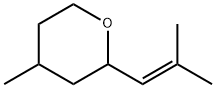
| Product Name: | FEMA 3236 | | Synonyms: | (Z)-Rose oxide;2-(2-methyl-1-propenyl)-4-methyltetrahydro-pyra;2H-Pyran, tetrahydro-4-methyl-2-(2-methyl-1-propenyl)-;2H-Pyran, tetrahydro-4-methyl-2-(2-methylpropenyl)-;4-Methyl-2-(2-methyl-1-propenyl)tetrahydro-2H-pyran;c-rose oxide;Pyran, 2-(2-methyl-1-propenyl)-4-methyltetrahydro-;Pyran, tetrahydro-2-(2-methyl-1-propenyl)-4-methyl- | | CAS: | 16409-43-1 | | MF: | C10H18O | | MW: | 154.25 | | EINECS: | 240-457-5 | | Product Categories: | | Mol File: | 16409-43-1.mol |
| FEMA 3236 Chemical Properties |
| Hazard Codes | Xi | | Risk Statements | 38-36/37/38 | | Safety Statements | 36-26 | | WGK Germany | 3 | | RTECS | UQ1470000 | | F | 10-23 | | HS Code | 29329990 | | toxicity | The acute oral LD50 value in rats was reported as 4.3 g/kg (3.7-4.9 g/kg) and the acute dermal LD50 value in rabbits as > 5 g/kg (Moreno, 1973). |
| FEMA 3236 Usage And Synthesis |
| Chemical Properties | Rose Oxide occurs in small quantities, mainly as the levorotatory
cis form, in essential oils (e.g., Bulgarian rose oil and geranium oil). Commercial
synthetic products are either optically active or inactive mixtures of the cis- and
trans-isomers. Their sensory properties depend on the starting material and the
method of synthesis.They are colorless liquids with a strong odor reminiscent
of geranium and rose oil. | | Chemical Properties | Tetrahydro-4-methyl-2-(2-methylpropen-1-yl)pyran has a powerful distinctive geranium top note. | | Occurrence | Reported found in the oils of rose (Bulgarian) and geranium (Réunion); both the cis- and the trans-form have been reportedly isolated from geranium oil. Unidentified isomers reported found in black currant berries, passion fruit, some types of Thymus and white wine. | | Preparation | Rose oxide is usually prepared from citronellol, which can be converted into a
mixture of two allyl hydroperoxides by photosensitized oxidationwith singlet oxygen.
Reduction of the hydroperoxideswith sodium sulfite yields the corresponding
diols . Treatmentwith dilute sulfuric acid results in allylic rearrangement and
spontaneous cyclization of one of the isomers; amixture of diastereoisomeric rose
oxides is thus formed. The unreacted diol isomer is separated by distillation. (?)-
Citronellol as the starting material yields an approximately 7 : 3 mixture of (?)-cisand
(?)-trans-rose oxide. Higher proportions of the cis-isomer may be obtained
by dehydration with a stronger acid.Other methods for the production of rose oxide starting from citronellol consist
of halogenation–dehalogenation reactions of citronellol.An alternative technical process does not use citronellol but starts from prenal
[107-86-8] and 3-methyl-3-buten-1-ol [763-32-6]. Under acidic conditions,
the reaction affords a mixture of isomers of dehydro rose oxide (C10H16O6; [1786-
08-9], [92356-05-3], [60857-05-8]). Subsequent hydrogenation using a
ruthenium/alumina catalyst leads to rose oxide.The proportion of cis-isomer can
be increased by isomerization under acidic conditions. | | Taste threshold values | Taste characteristics at 20 ppm: green, vegetative and herbal with a citrus nuance. | | Flammability and Explosibility | Nonflammable |
| FEMA 3236 Preparation Products And Raw materials |
|


 日本语
日本语 한국어
한국어 Français
 Deutsch
 España
 Türkiye