Other grades of this product :
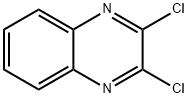
| 2,3-Dichloroquinoxaline Basic information |
| 2,3-Dichloroquinoxaline Chemical Properties |
| Melting point | 152-154 °C (lit.) | | Boiling point | 325.69°C (rough estimate) | | density | 1.4994 (rough estimate) | | refractive index | 1.6400 (estimate) | | storage temp. | Keep in dark place,Sealed in dry,Room Temperature | | Water Solubility | Insoluble in water | | form | Needles | | pka | -4.78±0.48(Predicted) | | color | Off-white to light brown | | BRN | 126076 | | Stability: | Stable. Incompatible with strong oxidizing agents. | | InChIKey | SPSSDDOTEZKOOV-UHFFFAOYSA-N | | CAS DataBase Reference | 2213-63-0(CAS DataBase Reference) | | EPA Substance Registry System | 2,3-Dichloroquinoxaline (2213-63-0) |
| 2,3-Dichloroquinoxaline Usage And Synthesis |
| Chemical Properties | solid | | Uses | 2,3-Dichloroquinoxaline is a dichlorinated quinoxaline derivative with antimicrobial activity. 2,3-Dichloroquinoxaline is used in the preparation of quinoxaline derivatives of cancer chemopreventive a
ctivity. | | Uses | 2,3-Dichloroquinoxaline was used in the synthesis of mono and 2,3-disubstituted quinoxalines. It was used in solid phase synthesis of HPLC chiral stationary phase containing the N,N′-dialkyl-2,3-diaminoquinoxaline group as a linking structure. | | Preparation | To a stirred solution of quinoxaline-2,3(1H,4H)-dione (5.00 g, 1.0 equiv.), POCl3 was added (20 ml) and refluxed at 100 °C for 3h. After completion of the reaction, as indicated by TLC, the reaction mass was distilled under vaccum and quenched with ice cold water. Off white semi solid was formed and is filtered through buchner funnel under vaccum to yield the 2,3-dichloroquinoxaline in excellent yield.Appearance: off white solid; Yield: 92% (5.64g); ESI-MS: (m/z) calcd. for C8H4Cl2N2: 197.98, found: 199.10 [M+H]+. | | General Description | Gray solid. Insoluble in water. | | Air & Water Reactions | Insoluble in water. | | Reactivity Profile | A halogenated amine. Amines are chemical bases. They neutralize acids to form salts plus water. These acid-base reactions are exothermic. The amount of heat that is evolved per mole of amine in a neutralization is largely independent of the strength of the amine as a base. Amines may be incompatible with isocyanates, halogenated organics, peroxides, phenols (acidic), epoxides, anhydrides, and acid halides. Flammable gaseous hydrogen is generated by amines in combination with strong reducing agents, such as hydrides. | | Fire Hazard | 2,3-Dichloroquinoxaline is probably combustible. | | Purification Methods | Recrystallise it from *C6H6 and dry it in a vacuum [Cheeseman J Chem Soc 1804 1955, Beilstein 23/7 V 144]. |
| 2,3-Dichloroquinoxaline Preparation Products And Raw materials |
|


 日本语
日本语 한국어
한국어 Français
 Deutsch
 España
 Türkiye