Other grades of this product :
| Product Name: | Mefenamic acid | | Synonyms: | Mefenamic Acid (200 mg);N-(2,3-Dimethylphenyl)anthranilic Acid
2-(2,3-Dimethylphenylamino)benzoic Acid
2-(2,3-Xylidino)benzoic Acid;CI 473,CN-35355;Mefenamic acid Solution, 100ppm;MefenaMic Aicd (API);2’,3’-dimethyl-2-diphenylaminecarboxylicaci;2-Diphenylaminecarboxylic acid, 2',3'-dimethyl-;ac.mefenamico | | CAS: | 61-68-7 | | MF: | C15H15NO2 | | MW: | 241.29 | | EINECS: | 200-513-1 | | Product Categories: | PONSTEL;Aromatic Carboxylic Acids, Amides, Anilides, Anhydrides & Salts;Amino Acids 13C, 2H, 15N;Amino Acids & Derivatives;Intermediates & Fine Chemicals;Pharmaceuticals;API's;61-68-7 | | Mol File: | 61-68-7.mol |
| Mefenamic acid Chemical Properties |
| Melting point | 230 °C | | Boiling point | 384.06°C (rough estimate) | | density | 1.0944 (rough estimate) | | refractive index | 1.5200 (estimate) | | storage temp. | 2-8°C | | solubility | Practically insoluble in water, slightly soluble in ethanol (96 per cent) and in methylene chloride. It dissolves in dilute solutions of alkali hydroxides | | form | neat | | pka | 4.2(at 25℃) | | color | White to Pale Yellow | | Water Solubility | It is soluble in acetone, chloroform, dichloromethane, methanol. Insoluble in water. | | Merck | 14,5798 | | InChIKey | HYYBABOKPJLUIN-UHFFFAOYSA-N | | CAS DataBase Reference | 61-68-7(CAS DataBase Reference) | | NIST Chemistry Reference | Mefenamic acid(61-68-7) |
| Mefenamic acid Usage And Synthesis |
| Description | Mefenamic acid is a kind of nonsteroidal anti-inflammatory (NSAID) drug belonging to the anthranilic acid derivatives class. It is mainly used for the short-term treatment of mild to moderate pain from various conditions. It is also used for reducing the pain and blood loss from menstrual condition as well as prevention of migraines. Moreover, it may also be used for treating gout attacks. Its mechanism is through inhibiting both the isoforms of COX and preventing the formation of prostaglandins. It is manufactured from 2-chlorobenzoic acid and 2,3-dimethylaniline.
| | References | http://www.webmd.com/drugs/2/drug-11586/mefenamic-acid-oral/details
https://en.wikipedia.org/wiki/Mefenamic_acid
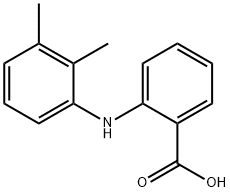
| | Chemical Properties | white or light yellow crystalline powder, odorless, insoluble in water, slightly soluble in ethanol, chloroform, slightly soluble in ether. Melting point 230-231°C, mefenamic acid is an anti-inflammatory analgesic with antipyretic, analgesic and anti-inflammatory effects. | | Originator | Ponstan,Parke Davis,UK,1963 | | Uses | Mefenamic acid is used for the same indications as flufenamic acid. Synonyms for this drug are
parkemed, ponstan, ponstel, and others. | | Uses | For the treatment of rheumatoid arthritis, osteoarthritis, dysmenorrhea, and mild to moderate pain, inflammation, and fever. | | Definition | ChEBI: An aminobenzoic acid that is anthranilic acid in which one of the hydrogens attached to the nitrogen is replaced by a 2,3-dimethylphenyl group. Although classed as a non-steroidal anti-inflammatory drug, its anti-inflammatory properties are considered to b
minor. It is used to relieve mild to moderate pain, including headaches, dental pain, osteoarthritis and rheumatoid arthritis. | | Indications | Mefenamic acid (Ponstel) is indicated only for analgesia
and primary dysmenorrhea when therapy will not exceed
1 week. | | Manufacturing Process | A mixture of 800 g of potassium o-bromo-benzoate, 1,500 ml of bis-(2- methoxyethyl)ether, 355 g of N-ethyl-morpholine, 375 g of 2,3- dimethylaniline, and 30 g of cupric acetate is heated gradually with stirring to 140°C over a period of 90 minutes. The hot reaction mixture is then acidified with 260 mi of concentrated hydrochloric acid and the acidified mixture divided into 2 equal portions. One liter of water is added to each portion and the mixtures allowed to cool. The N-(2,3-dimethylphenyl)anthranilic acid which separates upon cooling is collected by filtration and recrystallized from bis(2-methoxyethyl)ether; MP 229° to 230°C (corr.). | | Brand name | Ponstel (Sciele). | | Therapeutic Function | Analgesic | | Synthesis Reference(s) | The Journal of Organic Chemistry, 45, p. 2127, 1980 DOI: 10.1021/jo01299a020 | | General Description | Mefenamic acid (Ponstel, Ponstan) is one of the oldestNSAIDs, introduced into the market in 1967 for mild tomoderate pain and for primary dysmenorrhea. It is rapidly absorbed with peak plasma levels occurring 2 to 4 hoursafter oral administration. It undergoes hepatic benzylic hydroxylationof its 3'methyl group regioselectively into twoinactive metabolites, 3'-hydroxymethylmefenamic acid andthe 3'carboxylate metabolite (via further oxidation of thebenzylic alcohol group). The parent drugs and these metabolitesare conjugated with glucuronic acid and excreted primarilyin the urine. Thus, although patients with knownliver deficiency may be given lower doses, it is contraindicatedin patients with preexisting renal dysfunction.Common side effects associated with its use include diarrhea,drowsiness, and headache. The possibility of blood disordershas also prompted limitation of its administration to 7days. It is not recommended for children or during pregnancy. | | Biochem/physiol Actions | Mefenamic acid is an analgesic and anti-inflammatory drug. It acts as a cyclooxygenase (COX) enzyme inhibitor. It is hepatoxic and implicated in liver injury. Contrarily, mefenamic acid elicits neuroprotection in in vivo ischemic stroke models by inhibiting cell toxicity induced by glutamate. Mefenamic due its inhibitory effect on prostaglandin synthesis can be used in reducing edema and ache. | | Clinical Use | Mefenamic acid is synthesized from o-chlorobenzoic acid and 2,3-dimethylaniline under catalytic conditions.
Mefenamic acid is the only fenamic acid derivative that produces analgesia centrally and peripherally. Mefenamic
acid is indicated for the short-term relief of moderate pain and for primary dysmenorrhea. | | Synthesis | Mefenamic acid, N-(2,3-xylyl)anthranylic acid (3.2.19), is synthesized
in basically the same manner, by the reaction of the potassium salt of 2-bromobenzoic acid
with 2,3-dimethylaniline in the presence of copper (II) acetate [80,81]. | | Drug interactions | Potentially hazardous interactions with other drugs
ACE inhibitors and angiotensin-II antagonists:
antagonism of hypotensive effect; increased risk of
nephrotoxicity and hyperkalaemia.
Analgesics: avoid concomitant use of 2 or more
NSAIDs, including aspirin (increased side effects);
avoid with ketorolac (increased risk of side effects
and haemorrhage).
Antibacterials: possibly increased risk of convulsions
with quinolones.
Anticoagulants: effects of coumarins and
phenindione enhanced; possibly increased risk of
bleeding with heparins, dabigatran and edoxaban -
avoid long term use with edoxaban.
Antidepressants: increased risk of bleeding with
SSRIs and venlaflaxine.
Antidiabetics: effects of sulphonylureas enhanced.
Antiepileptics: possibly increased phenytoin
concentration.
Antivirals: increased risk of haematological toxicity
with zidovudine; concentration possibly increased by
ritonavir.
Ciclosporin: may potentiate nephrotoxicity.
Cytotoxics: reduced excretion of methotrexate;
increased risk of bleeding with erlotinib.
Diuretics: increased risk of nephrotoxicity;
antagonism of diuretic effect; hyperkalaemia with
potassium-sparing diuretics.
Lithium: excretion decreased.
Pentoxifylline: increased risk of bleeding.
Tacrolimus: increased risk of nephrotoxicity. | | Metabolism | Mefenamic acid is absorbed rapidly following oral administration, with peak plasma levels being attained within 2 to 4
hours. It is highly bound to plasma proteins (78.5%) and has a plasma half-life of 2 to 4 hours. Metabolism occurs
through regioselective oxidation of the 3′-methyl group and glucuronidation of mefenamic acid and its metabolites.
Urinary excretion accounts for approximately 50 to 55% of an administered dose, with unchanged drug accounting for
6%, the 3′-hydroxymethyl metabolite (primarily as the glucuronide) accounting for 25%, and the remaining 20% as the
dicarboxylic acid (of which 30% is the glucuronide conjugate). These metabolites are essentially
inactive. |
| Mefenamic acid Preparation Products And Raw materials |
|


 日本语
日本语 한국어
한국어 Français
 Deutsch
 España
 Türkiye