Other grades of this product :
| 2-Methyl anthraquinone Basic information |
| 2-Methyl anthraquinone Chemical Properties |
| Melting point | 170-173 °C (lit.) | | Boiling point | 236-238 °C/10 mmHg (lit.) | | density | 1.1404 (rough estimate) | | vapor pressure | 0Pa at 25℃ | | refractive index | 1.6600 (estimate) | | Fp | 209 °C | | storage temp. | 2-8°C | | form | powder to crystal | | color | Light orange to Yellow to Green | | Water Solubility | Soluble in water 1.234 mg/L @ 25°C. | | Merck | 14,6021 | | BRN | 2050523 | | InChIKey | NJWGQARXZDRHCD-UHFFFAOYSA-N | | LogP | 3.4 at 25℃ | | CAS DataBase Reference | 84-54-8(CAS DataBase Reference) | | NIST Chemistry Reference | 9,10-Anthracenedione, 2-methyl-(84-54-8) | | EPA Substance Registry System | 2-Methylanthraquinone (84-54-8) |
| Hazard Codes | Xi,N | | Risk Statements | 51/53 | | Safety Statements | 22-24/25-61 | | RIDADR | UN 3077 9/PG 3 | | WGK Germany | 3 | | Hazard Note | Irritant | | TSCA | Yes | | HS Code | 29146990 |
| 2-Methyl anthraquinone Usage And Synthesis |
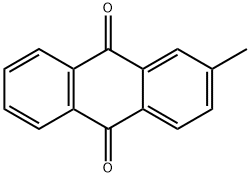
| Chemical Properties | YELLOW TO GREEN-YELLOW FINE POWDER | | Uses | 2-Methylanthraquinone is used as a pharmaceutical intermediate. It is used in smog dyes.2-Methylanthraquinone may be used in the preparation of potential bioreducible anthraquinone derivatives. | | Uses | 2-Methylanthraquinone may be used in the preparation of potential bioreducible anthraquinone derivatives. | | Definition | ChEBI: 2-methylanthraquinone is an anthraquinone that is 9,10-anthraquinone in which the hydrogen at position 2 is substituted by a methyl group. It derives from a 9,10-anthraquinone. | | Reactions | The compound is produced by the reaction of phthalic anhydride and toluene. It can be chlorinated to give 1-chloro-2-methylanthraquinone. Nitration gives 1-nitro-2-methylanthraquinone, which can be reduced to 1-amino-2-methyl derivative. Oxidation of the methyl group gives anthraquinone-2-carboxylic acid. | | Synthesis Reference(s) | Canadian Journal of Chemistry, 44, p. 2881, 1966 DOI: 10.1139/v66-428 | | Synthesis Reference(s) | Organic Syntheses, Coll. Vol. 1, p. 353, 1941Tetrahedron Letters, 24, p. 5499, 1983 DOI: 10.1016/S0040-4039(00)94122-4 | | Flammability and Explosibility | Notclassified | | Purification Methods | Crystallise the quinone from EtOH, then sublime it. It has max at 257, 275 and 330nm (EtOH). [Hersbery & Fieser J Am Chem Soc 63 2562 1941, Beilstein 7 H 809, 7 III 4104, 7 IV 2574.] |
| 2-Methyl anthraquinone Preparation Products And Raw materials |
|


 日本语
日本语 한국어
한국어 Français
 Deutsch
 España
 Türkiye