Other grades of this product :
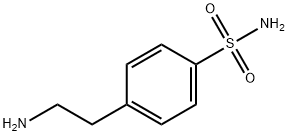
| 4-(2-Aminoethyl)benzenesulfonamide Basic information | | Uses |
| 4-(2-Aminoethyl)benzenesulfonamide Chemical Properties |
| Melting point | 150-152 °C (lit.) | | Boiling point | 387.4±44.0 °C(Predicted) | | density | 1.2581 (rough estimate) | | vapor pressure | 0Pa at 25℃ | | refractive index | 1.5690 (estimate) | | storage temp. | Keep in dark place,Inert atmosphere,Room temperature | | solubility | DMSO (Slightly), Methanol (Slightly) | | pka | 10.16±0.10(Predicted) | | form | Solid | | color | White | | Water Solubility | 15.5g/L at 20℃ | | LogP | -3.1 at 19.8℃ | | CAS DataBase Reference | 35303-76-5(CAS DataBase Reference) |
| 4-(2-Aminoethyl)benzenesulfonamide Usage And Synthesis |
| Uses | 4-(2-Aminoethyl)benzenesulfonamide is used as the starting material in the synthesis of Des(5-methylpyrazinecarbonyl) trans-4-Methyl Glipizide (D292605); a degradation product of Glimepiride (G410150) which is a sulfonylurea hypoglycemic agent and an antidiabetic. 4-(2-Aminoethyl)benzenesulfonamide is also used as a reagent in the synthesis of deorphaning pyrrolopyrazines as potent multi-target antimalarial agents. | | Chemical Properties | white to yellowish crystalline powder | | Uses | 4-(2-Aminoethyl)benzenesulfonamide was used to develop a model system to study the implementation of a microfluid chip required for Fourier transform measurements of biochemical interactions. | | General Description | The human hepatocellular carcinoma (HCC) cells were treated with its inhibitor 4-(2-aminoethyl)benzenesulfonamide. | | Flammability and Explosibility | Notclassified |
| 4-(2-Aminoethyl)benzenesulfonamide Preparation Products And Raw materials |
|


 日本语
日本语 한국어
한국어 Français
 Deutsch
 España
 Türkiye