Other grades of this product :
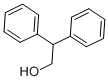
| 2,2-DIPHENYLETHANOL Basic information |
| 2,2-DIPHENYLETHANOL Chemical Properties |
| Melting point | 53-56 °C (lit.) | | Boiling point | 190-192 °C/12 mmHg (lit.) | | density | 1.079 | | refractive index | 1.5680 (estimate) | | Fp | >230 °F | | storage temp. | Sealed in dry,Room Temperature | | form | Crystalline Powder | | pka | 14.62±0.10(Predicted) | | color | White | | Stability: | Stable. Combustible. Incompatible with strong oxidizing agents. | | InChIKey | NYLOEXLAXYHOHH-UHFFFAOYSA-N |
| Hazard Codes | Xi | | WGK Germany | 3 | | HazardClass | IRRITANT | | HS Code | 29062900 |
| 2,2-DIPHENYLETHANOL Usage And Synthesis |
| Chemical Properties | white powder | | Synthesis Reference(s) | Journal of the American Chemical Society, 78, p. 5694, 1956 DOI: 10.1021/ja01602a063The Journal of Organic Chemistry, 26, p. 4199, 1961 DOI: 10.1021/jo01069a005 | | General Description | 2,2-Diphenylethanol participates in Meerwein-Ponndorf-Verley type reduction reaction of trans-stilbene oxide with boron triisopropoxide in tetrahydrofuran. |
| 2,2-DIPHENYLETHANOL Preparation Products And Raw materials |
|


 日本语
日本语 한국어
한국어 Français
 Deutsch
 España
 Türkiye