Other grades of this product :
| Lomefloxacin hydrochloride Basic information |
| Lomefloxacin hydrochloride Chemical Properties |
| Melting point | 290-3000C | | storage temp. | Sealed in dry,Store in freezer, under -20°C | | solubility | 1 M NaOH: soluble50mg/mL | | form | powder to crystal | | color | white to off-white | | Merck | 14,5562 | | CAS DataBase Reference | 98079-52-8(CAS DataBase Reference) |
| Hazard Codes | Xn | | Risk Statements | 22 | | WGK Germany | 3 | | RTECS | VB1997500 | | HS Code | 29339900 |
| Lomefloxacin hydrochloride Usage And Synthesis |
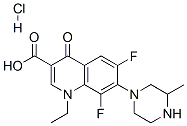
| Description | Lomefloxacin hydrochloride is the hydrochloride form of Lomefloxacin. Lomefloxacin is a bactericidal fluoroquinolone agent that is active against gram-negative and gram-positive organisms. Lomefloxacin inhibits bacterial DNA gyrase (topoisomerase II) and topoisomerase IV, which are needed for the transcription and replication of bacterial DNA. DNA gyrase is thought to be the primary quinolone target for gram-negative bacteria. Topoisomerase IV is thought to be the primary target in gram-positive organisms. The inhibition of the topoisomerases results in strand breakage of the bacterial chromosome, supercoiling, and resealing. Therefore, DNA replication and transcription is inhibited. Lomefloxacin can be used to treat many kinds of infections such as respiratory, urinary tract, obstetric, gynaecological, joint, skin, oral, ear, nose, throat and eye infections. Compared with other quinolone antibacterial drugs, lomefloxacin has certain advantages such as convenient administration and no necessity of theophylline dosage adjustment.
| | Description | Lomefloxacin is an orally bioavailable, broad-spectrum fluoroquinolone antibiotic. In vitro, it inhibits growth of N. gonorrhoeae, E. coli, K. pneumoniae, P. vulgaris, S. epidermidis, and M. morganii (MIC90s = 0.1, 0.39, 0.39, 0.39, 0.39, and 0.78 μg/ml, respectively). It also inhibits growth of S. aureus and methicillin-resistant S. aureus (MRSA; MIC90 = 3.13 μg/ml for both) and of H. influenzae and ampicillin-resistant H. influenzae (MIC90 = 0.1 μg/ml for both). In vivo, lomefloxacin inhibits the growth of P. mirabilis, E. coli, K. pneumoniae, and S. aureus (ED50s = 1.39, 1.45, 1.78, and 6.66 mg/kg, respectively) in mouse models of systemic infection. It inhibits bacterial DNA gyrase, thereby inhibiting DNA synthesis and bacterial growth. Formulations containing lomefloxacin have been used in the treatment of bronchitis and urinary tract bacterial infections. | | Chemical Properties | White powder with no smell, bitter taste | | Originator | Foxil,Sarabhai Chemicals,India | | Uses | Fluorinated quinolone antibacterial. DNA gyrase antagonist | | Definition | ChEBI: The hydrochloride salt of lomefloxacin. It is administered by mouth to treat bacterial infections including bronchitis and urinary tract infections. It is also used topically as eye drops for the treatment of bacterial conjunctivitis, and as ear drops for
he treatment of otitis externa and otitis media. | | Manufacturing Process | A mixture of 1.00 g of 1-ethyl-6,7,8-trifluoro-1,4-dihydro-4-oxoquinoline-3-
carboxylic acid, 1.10 g of 2-methylpiperazine and 10 ml of pyridine was
heated for 15 minutes under reflux. The reaction mixture was evaporated and
methanol was added to the residue. The precipitate was filtered and
recrystallized from ethanol to give 0.36 g of the 1-ethyl-6,8-difluoro-1,4-
dihydro-7-(3-methyl-1-piperazinyl)-4-oxoquinoline-3-carboxylic acid as
colorless needles, melting point 239.0-240.5°C.By the usual manner the hydrochloride was prepared and recrystallized from
water as colorless needles, melting point 290-300°C (decomp.). | | Brand name | Maxaquin (Pharmacia). | | Therapeutic Function | Antibacterial | | References | Wadworth, A. N., and K. L. Goa. "Lomefloxacin. A review of its antibacterial activity, pharmacokinetic properties and therapeutic use. " Drugs 42.6(1991): 1018-60.
Symonds, W. T., and D. E. Nix. "Lomefloxacin and temafloxacin: two new fluoroquinolone antimicrobials." Clin Pharm 11.9(1992): 753-66.
|
| Lomefloxacin hydrochloride Preparation Products And Raw materials |
|


 日本语
日本语 한국어
한국어 Français
 Deutsch
 España
 Türkiye