Other grades of this product :
| Panobinostat Basic information |
| Panobinostat Chemical Properties |
| Melting point | 114-117?C | | density | 1.241±0.06 g/cm3(Predicted) | | storage temp. | -20°C Freezer, Under Inert Atmosphere | | solubility | Soluble in DMSO (up to 100 mg/ml) or in Ethanol (up to 5 mg/ml with warming). | | form | solid | | pka | 8.71±0.23(Predicted) | | color | Off-white | | Stability: | Stable for 1 year from date of purchase as supplied. Solutions in DMSO or ethanol may be stored at -20° for up to 1 month. |
| Panobinostat Usage And Synthesis |
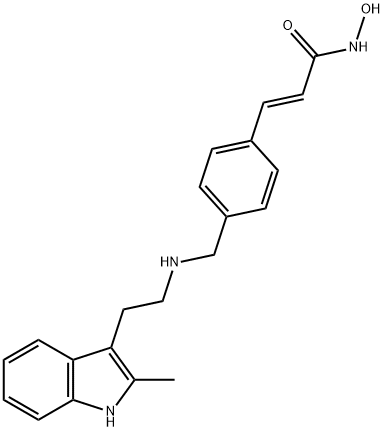
| Description | Panobinostat is a potent inhibitor of all histone deacetylases (HDACs), with Ki values ranging from 0.6 to 31 nM for HDAC1-11. Through this action, it leads to acetylation of a range of cellular proteins, resulting in cell cycle arrest and apoptosis in cancer cells. It has potential applications in several different forms of cancer as well as in spinal muscular atrophy and HIV therapy. | | Chemical Properties | Yellow Solid | | Uses | The novel labelled histone deacetylase inhibitor, LBH589, induces expression of DNA damage response genes and apoptosis in Ph- acute lymphoblastic leukemia cells. | | Uses | The novel histone deacetylase inhibitor, LBH589, induces expression of DNA damage response genes and apoptosis in Ph- acute lymphoblastic leukemia cells. | | Definition | ChEBI: A hydroxamic acid obtained by formal condensation of the carboxy group of (2E)-3-[4-({[2-(2-methylindol-3-yl)ethyl]amino}methyl)phenyl]prop-2-enoic acid with the amino group of hydroxylamine. A histone deacetylase inhibitor used (as its la
tate salt) in combination with bortezomib and dexamethasone for the treatment of multiple myeloma. | | Clinical Use | Histone deacetylase (HDAC) inhibitor:
Treatment of relapsed and/or refractory multiple
myeloma | | Drug interactions | Potentially hazardous interactions with other drugs
Analgesics: avoid with dextromethorphan possibly
increased risk of ventricular arrhythmias with
methadone - avoid.
Anti-arrhythmics: increased risk of ventricular
arrhythmias with amiodarone and possibly
disopyramide - avoid.
Antibacterials: increased risk of ventricular
arrhythmias with clarithromycin and moxifloxacin -
avoid; avoid with rifampicin.
Antidepressants: avoid with St John’s wort.
Antiepileptics: avoid with carbamazepine,
fosphenytoin, phenobarbital, phenytoin and
primidone.
Antifungals: concentration increased by ketoconazole
and possibly posaconazole and voriconazole - reduce
panobinostat dose; concentration possibly increased
by itraconazole - avoid.
Antimalarials: possibly increased risk of ventricular
arrhythmias with chloroquine - avoid.
Antipsychotics: avoid with pimozide.
Antivirals: concentration possibly increased
by ritonavir and saquinavir - reduce dose of
panobinostat.
Beta-blockers: possibly increased risk of ventricular
arrhythmias with sotalol - avoid.
Grapefruit juice: avoid concomitant use.
5HT3
antagonists: possibly increased risk of
ventricular arrhythmias with granisetron and
ondansetron - avoid with granisetron. | | Metabolism | Panobinostat is extensively metabolised, and a large
fraction of the dose is metabolised before reaching
the systemic circulation by reduction, hydrolysis,
oxidation and glucuronidation. Oxidative metabolism
of panobinostat played a less prominent role, with
approximately 40% of the dose eliminated by this
pathway. Cytochrome P450 3A4 (CYP3A4) is the main
oxidation enzyme, with potential minor involvement of
CYP2D6 and 2C19.
Panobinostat represented 6-9% of the drug-related
exposure in plasma. The parent substance is deemed to
be responsible for the overall pharmacological activity of
panobinostat.
After a single oral dose of [14C]-panobinostat in patients,
29-51% of administered radioactivity is excreted in the
urine and 44-77% in the faeces. Unchanged panobinostat
accounted for <2.5% of the dose in urine and <3.5% of
the dose in faeces. | | References | 1) Geng et al. (2006), Histone deacetylase (HDAC) inhibitor LBH589 increases duration of gamma H2AX foci and confines HDAC4 to the cytoplasm in irradiated non-small cell lung cancer; Cancer Res., 66 11298
2) George et al. (2005), Combination of the histone deacetylase inhibitor LBH589 and the hsp90 inhibitor 17-AAG is highly active against human CML-BC cells and AML cells with activating mutation of FLT-3; Blood, 105 1768
3) Maiso et al. (2006), The histone deacetylase inhibitor LBH589 is a potent antimyeloma agent that overcomes drug resistance; Cancer Res., 66 5781 |
| Panobinostat Preparation Products And Raw materials |
|


 日本语
日本语 한국어
한국어 Français
 Deutsch
 España
 Türkiye