Other grades of this product :
| Lisinopril Basic information |
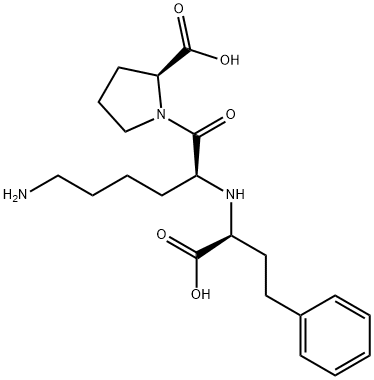
| Product Name: | Lisinopril | | Synonyms: | (S)-1-[(S)-6-AMINO-2-((S)-1-CARBOXY-3-PHENYL-PROPYLAMINO)-HEXANOYL]-PYRROLIDINE-2-CARBOXYLIC ACID;TENSOPRIL;VIVATEC;ZESTRIL;mk522;PRINIL;PRINIVIL;n-{n-[(s)-1-carboxy-3-phenylpropyl]-l-lysyl}-l-proline | | CAS: | 76547-98-3 | | MF: | C21H31N3O5 | | MW: | 405.49 | | EINECS: | 278-488-1 | | Product Categories: | | Mol File: | 76547-98-3.mol |
| Lisinopril Chemical Properties |
| Melting point | 162-165 °C | | Boiling point | 666.4±55.0 °C(Predicted) | | density | 1.251±0.06 g/cm3(Predicted) | | storage temp. | Keep in dark place,Inert atmosphere,2-8°C | | solubility | H2O: ≥10 mg/mL | | form | solid | | pka | 2.18±0.10(Predicted) | | color | white | | CAS DataBase Reference | 76547-98-3(CAS DataBase Reference) |
| Lisinopril Usage And Synthesis |
| Description | Lisinopril is an angiotensin-converting enzyme (ACE) inhibitor (IC50 = 1.2 nM). It reduces the formation of endothelin-1 and increases nitric oxide (NO) in human vascular endothelial cells when used at a concentration of 0.1 nM. Lisinopril inhibits the pressor response to angiotensin I in anesthetized rats and dogs (ID50s = 2.3 and 6.5 μg/kg, respectively). | | Originator | Acebitor 5,Biddle Sawyer,India | | Uses | Labeled Lisinopril, intended for use as an internal standard for the quantification fo Lisinopril by GC- or LC-mass spectrometry. | | Uses | Lisinopril is an antihypertensive medication. | | Manufacturing Process | 2-Oxo-4-phenylbutyric acid and t-BOC-L-lysyl-L-proline are condensed in the
presence of sodium cyanoborohydride. Essentially all of the t-BOC protecting
group is cleaved when the product is absorbed on strong acid ion exchange
resin. The crude N-(1-carboxy-3-phenylpropyl)-L-lysyl-L-proline is eluted from
the resin with 10% ammonia, freeze dried, and purified by gel filtration
chromatography (LH-20). A minute peak for t-BOC protons in the NMR
spectrum disappears when the product is treated with ethyl acetate that is 4
N in hydrogen chloride gas. The NMR spectrum of the resulting HCl salt of the
product is consistent with structure. The mass spectrum shows a molecular
ion at 693 m/e for the tetrasilylated species. Chromatography on XAD-2 resin
using 3.5% acetonitrile in 0.1 molar ammonium hydroxide affords N-α-((1S)-
1-carboxy-3-phenylpropyl)-L-lysyl-L-proline. The last peptide can be produced
if 2-oxo-4-phenylbutyric acid and N-t-Boc-L-lysyl-L-proline are condensed in
the presence of sodium cyanoborohydride. The product is absorbed on strong
acid ion exchange resin, and eluted with 2% pyridine in water. Product-rich
cuts are stripped to a glass and treated with 4 N HCl in ethylacetate to
remove the t-Boc protecting group. The resulting hydrochloride salt is
converted to the free base by absorbing on strong acid ion exchange resin and
eluting with 2% pyridine in water. Freeze drying of product-rich cuts affords
N-α-(1-carboxy-3-phenylpropyl)-L-lysyl-L-proline as a white fluffy solid. The
NMR spectrum is consistent with structure. The mass spectrum shows a
molecular ion at 549 for the disilylated species. Chromatography affords the
desired isomer. | | Brand name | Prinivil (Merck); Zestril (AstraZeneca). | | Therapeutic Function | Antihypertensive |
| Lisinopril Preparation Products And Raw materials |
|


 日本语
日本语 한국어
한국어 Français
 Deutsch
 España
 Türkiye