Other grades of this product :
| Diglycidyl 1,2-cyclohexanedicarboxylate Basic information |
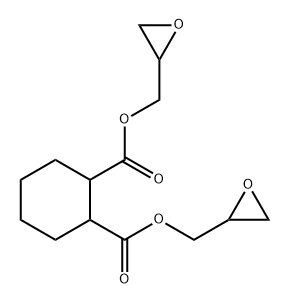
| Product Name: | Diglycidyl 1,2-cyclohexanedicarboxylate | | Synonyms: | 1,2-cyclohexanedicarboxylicacid,bis(2,3-epoxypropyl)ester;1,2-cyclohexanedicarboxylicacid,bis(oxiranylmethyl)-;1,2-Cyclohexanedicarboxylicacid,bis(oxiranylmethyl)ester;cyclohexane-1,2-dicarboxylicacidbis(oxiranylmethyl)ester;diglycidylesterkyselinyhexahydroftalove;diglycidylesterofhexahydrophthalicacid;hexahydro-phthalicacidiglycidylester;lekutherm2159 | | CAS: | 5493-45-8 | | MF: | C14H20O6 | | MW: | 284.3 | | EINECS: | 226-826-3 | | Product Categories: | Oxiranes;Simple 3-Membered Ring Compounds | | Mol File: | 5493-45-8.mol |
| Diglycidyl 1,2-cyclohexanedicarboxylate Chemical Properties |
| Hazard Codes | Xi | | Risk Statements | 36/37/38-43 | | Safety Statements | 26-36 | | WGK Germany | 1 | | RTECS | GU9070000 | | HS Code | 29172090 |
| Diglycidyl 1,2-cyclohexanedicarboxylate Usage And Synthesis |
| Chemical Properties | Colorless or light yellow liquid | | Uses | It is used in epoxy-based industrial coatings and paints. | | General Description | Clear yellow viscous liquid. | | Air & Water Reactions | Insoluble in water. | | Reactivity Profile | Diglycidyl 1,2-cyclohexanedicarboxylate is incompatible with strong oxidizers, acids and alkalis. | | Fire Hazard | Diglycidyl 1,2-cyclohexanedicarboxylate is combustible. | | Carcinogenicity | HPADGE was tested in vitro for
gene mutation effects in S. typhimurium at concentrations up
to 231 mg/mL and was positive in strains TA100 and
TA1535. HPADGE has also been reported as positive
in the mouse lymphoma assay. Negative results were
found in the BALB/3T3 fibroblast transformation assay
at concentrations up to 30 mg/mL. In vivo,
HPADGE administered orally in a single dose of 1250,
2500, or 5000 mg/kg to Chinese hamsters produced a statistically
significant increase in SCEs in bone marrow cells
at the two higher dose levels. Mice given a single oral
dose of 500 or 1000 mg/kg had a statistically significant
increase in the frequency of micronucleated polychromatic
erythrocytes compared to negative controls. |
| Diglycidyl 1,2-cyclohexanedicarboxylate Preparation Products And Raw materials |
|


 日本语
日本语 한국어
한국어 Français
 Deutsch
 España
 Türkiye