Other grades of this product :
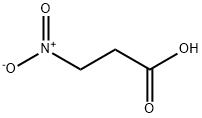
| 3-NITROPROPIONIC ACID Basic information |
| 3-NITROPROPIONIC ACID Chemical Properties |
| Melting point | 68-70 °C (lit.) | | Boiling point | 222.3°C (rough estimate) | | density | 1.6731 (rough estimate) | | refractive index | 1.4940 (estimate) | | storage temp. | 2-8°C | | solubility | alcohol: 100 mg/mL, may be light yellow | | form | powder or crystals | | pka | 3.66±0.10(Predicted) | | color | white to light yellow | | BRN | 1759889 | | Stability: | Stable. Incompatible with strong oxidizing agents, bases, reducing agents. | | EPA Substance Registry System | 3-Nitropropanoic acid (504-88-1) |
| 3-NITROPROPIONIC ACID Usage And Synthesis |
| Chemical Properties | gold crystalline solid | | Uses | antineoplastic | | Uses | 3-Nitropropionic acid has been used:- to generate multiple system atropy-parkinsoniam (MSA-P) model in rat to evaluate its effect on embryonic striatal and mesencephalic grafts
- to inject into the nigrostriatal dopaminergic pathway in rats in order to examine its specific effects on the dopamine system
- as succinate dehydrogenase (SDH) inhibitor for LUHMES neurons and cell lines
| | General Description | Golden crystals (from chloroform). | | Air & Water Reactions | Water soluble. | | Reactivity Profile | 3-NITROPROPIONIC ACID is incompatible with bases, oxidizing agents and reducing agents. | | Fire Hazard | Flash point data for 3-NITROPROPIONIC ACID are not available; however, 3-NITROPROPIONIC ACID is probably combustible. | | Biological Activity | 3-nitropropionic acid is an irreversible inhibitor of mitochondrial respiratory complex ii (succinate dehydrogenase), which impairs cellular energy metabolism by inhibiting succinate dehydrogenase and reducing atp production. also, 3-nitropropionic acid can cause the generation and release of reactive oxygen species (ros) from mitochondria (the main source of cellular oxidative stress), mitochondrial dna damage, as well as loss of mitochondrial function.1. huang ls, sun g, cobessi d, et al. 3-nitropropionic acid is a suicide inhibitor of mitochondrial respiration that, upon oxidation by complex ii, forms a covalent adduct with a catalytic base arginine in the active site of the enzyme. journal of biological chemistry, 2006, 281(9): 5965-5972.2. zhang jq, shen m, zhu cc, et al. 3-nitropropionic acid induces ovarian oxidative stress and impairs follicle in mouse. plos one, 2014, 9(2): e86589.3. mandavilli bs, boldogh i, van houten b. 3-nitropropionic acid-induced hydrogen peroxide, mitochondrial dna damage, and cell death are attenuated by bcl-2 overexpression in pc12 cells. brain research. molecular brain research, 2005, 133(2): 215-223. | | Biochem/physiol Actions | Excitotoxin shown to cause brain lesions similar to those of Huntington′s disease. | | Safety Profile | Poison by intravenous andintraperitoneal routes. Questionable carcinogen withexperimental neoplastigenic data. Mutation data reported.When heated to decomposition it emits toxic fumes ofNOx. |
| 3-NITROPROPIONIC ACID Preparation Products And Raw materials |
|


 日本语
日本语 한국어
한국어 Français
 Deutsch
 España
 Türkiye