Other grades of this product :
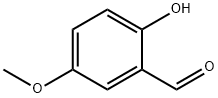
| 2-Hydroxy-5-methoxybenzaldehyde Basic information |
| 2-Hydroxy-5-methoxybenzaldehyde Chemical Properties |
| Melting point | 4 °C (lit.) | | Boiling point | 103 °C/2.5 mmHg (lit.) | | density | 1.219 g/mL at 25 °C (lit.) | | refractive index | n20/D 1.578(lit.) | | Fp | >230 °F | | storage temp. | Store below +30°C. | | form | Liquid | | pka | 8.66±0.18(Predicted) | | color | Clear yellow | | Water Solubility | Miscible with chloroform. Slightly miscible with water. | | Sensitive | Air Sensitive | | BRN | 1100532 | | InChIKey | FZHSPPYCNDYIKD-UHFFFAOYSA-N | | CAS DataBase Reference | 672-13-9(CAS DataBase Reference) | | NIST Chemistry Reference | Benzaldehyde, 2-hydroxy-5-methoxy-(672-13-9) |
| 2-Hydroxy-5-methoxybenzaldehyde Usage And Synthesis |
| Chemical Properties | clear yellow liquid | | Uses | 2-Hydroxy-5-methoxybenzaldehyde is employed to study electroantennogram response of the vine weevil (Otiorhynchus sulcatus F) to a broad range of volatile plant compounds. It plays an important role in the preparation of tetradentate Schiff base compounds. Further, it is used in the preparation 6-methoxy-3-nitro-2H-chromene by using dibutylamine as a reagent. | | Uses | 2-Hydroxy-5-methoxybenzaldehyde was used to synthesize radiolabeling precursor desmethyl-PBR06. It was used to study electroantennogram response of the vine weevil (Otiorhynchus sulcatus F.) to a broad range of volatile plant compounds. It was used in the synthesis of tetradentate Schiff base compounds. | | General Description | 2-Hydroxy-5-methoxybenzaldehyde has acaricidal activity against Tyrophagus putrescentiae. |
| 2-Hydroxy-5-methoxybenzaldehyde Preparation Products And Raw materials |
|


 日本语
日本语 한국어
한국어 Français
 Deutsch
 España
 Türkiye