Other grades of this product :
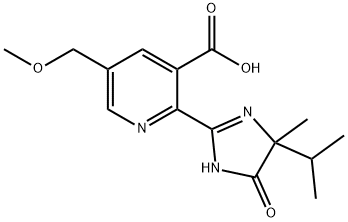
| Product Name: | Imazamox | | Synonyms: | 2-(4-Isopropyl-4-methyl-5-oxo-2-imidazolin-2-yl)-5-methoxymethylnicotinic acid;IMAZAMOX;(RS)-2-(4-isopropyl-4-methyl-5-oxo-2-imidazolin-2-yl)-5-methoxymethylnicotinic acid;Odyseey;Raptor;Sweeper;Imazamox PESTANAL;AC299263 | | CAS: | 114311-32-9 | | MF: | C15H19N3O4 | | MW: | 305.33 | | EINECS: | | Product Categories: | | Mol File: | 114311-32-9.mol |
| Imazamox Chemical Properties |
| Hazard Codes | N | | Risk Statements | 50/53 | | Safety Statements | 60-61 | | RIDADR | UN3077 9/PG 3 | | WGK Germany | 3 | | Hazardous Substances Data | 114311-32-9(Hazardous Substances Data) | | Toxicity | LD50 (technical grade) orally in rats: >5000 mg/kg; dermally in rabbits: >4000 mg/kg; LC50 by inhalation in rats: >6.3 mg/l (Glover) |
| Imazamox Usage And Synthesis |
| Description | Imazamox (2-[4,5-dihydro-4-methyl-4-(1-methylethyl)-5-oxo-1H-imidazol-2-yl]-5- (methoxymethyl)-3-pyridinecarboxylic acid) is a systemic herbicide that moves throughout the plant tissue and prevents plants from producing a necessary enzyme, acetolactate synthase (ALS), which is not found in animals. Susceptible plants will stop growing soon after treatment, but plant death and decomposition will occur over several weeks.
Imazamox is used for the control of vegetation in and around aquatic sites and terrestrial non-crop sites. It is herbicidally active on many submerged, emergent, and floating broadleaf and monocot aquatic plants in and around standing and slow- moving water bodies. It is used as herbicide on sunflower seed, alfalfa, oilseed rape and soya bean seed and used for the control of most annual and perennial broadleaf weeds and grasses, woody species, and riparian and emergent aquatic weed species.
Imazamox is only moderately persistent, and it degrades aerobically in the soil to a non-herbicidal metabolite which is immobile or moderately mobile. Imazamox also degrades by aqueous photolysis.
| | References | [1] http://dnr.wi.gov/lakes/plants/factsheets/ImazamoxFactsheet.pdf
[2] https://www.efsa.europa.eu/en/efsajournal/pub/4432
[3] http://www.mass.gov/eea/docs/agr/pesticides/aquatic/imazamox.pdf
| | Description | Imazamox is registered throughout the world for use
in leguminous crops, including soybeans, alfalfa, and
edible beans, as well as in imidazolinone-resistant
crops (9). A nonionic surfactant or oil adjuvant is
required for maximum activity. Imazamox
is much more active when applied post-emergent to the
weeds compared with pre-emergence application (9). One
difference between imazamox and other imidazolinones is
the much shorter interval needed before sensitive follow
crops can be planted. This difference is due to the more
rapid degradation of imazamox in the soil compared with
other imidazolinones. | | Chemical Properties | Off-White Solid | | Uses | Imazamox is an imidazolinone based acetolactate synthase inhibitor that is utilized as a herbicide for weed control. | | Uses | Herbicide. | | Pharmacology | Imazamox kills plants by inhibiting acetolactate synthase
(ALS) (I50 = 1 μM), which is the first common enzyme in
the biosynthesis of the branched chain amino acids, valine,
leucine, and isoleucine. Imazamox is rapidly absorbed
through the leaves of plants. Once it enters the plant,
imazamox rapidly translocates to the growing points and
growth ceases within 1 day after herbicide application,
followed by chlorosis and then by necrosis of the growing
points. Total plant death will occur within 2 to 3 weeks
after treatment. | | Metabolism | Plant Metabolism. The selectivity of imazamox is due to
differential rates and routes of metabolism in tolerant
crops versus susceptible weeds (10). The primary
metabolic route is hydroxylation followed by conjugation
to glucose. In imidazolinone-resistant crops, the primary
mechanism of selectivity is due to an altered acetolactate
synthase that is not inhibited by imazamox (11).
Animal Metabolism. Metabolism studies in the rat
showed that imazamox is rapidly excreted in the urine.
There was no accumulation of imazamox or any of its
derivatives in the liver, kidney, muscle, fat, or blood (9). | | Toxicity evaluation | Imazamox has shown no mutagenic or genotoxic activity in
the Ames assay, mammalian cell gene mutation assay, in vitro chromosome aberration assay, in vitro unscheduled DNA synthesis (URS) assay, or the in vivo dominant lethal
assay inmale rats. The acute toxicity and effects on wildlife
and soilmicroflora of imazamox are shown in Table 4. This
herbicide also has a low potential for bioaccumulation
in fish. |
| Imazamox Preparation Products And Raw materials |
|


 日本语
日本语 한국어
한국어 Français
 Deutsch
 España
 Türkiye