Other grades of this product :
| 2,6-Dichlorophenol Basic information |
| 2,6-Dichlorophenol Chemical Properties |
| Melting point | 64-66 °C (lit.) | | Boiling point | 218-220 °C (lit.) | | density | 1.6530 | | refractive index | 1.4430 (estimate) | | Fp | 218-220°C | | storage temp. | 2-8°C | | solubility | 1.9g/l | | form | Crystals or Crystalline Powder | | pka | pK1:6.78 (25°C) | | color | White to yellow | | Water Solubility | <0.1 g/100 mL at 20 ºC | | Merck | 14,3073 | | BRN | 1447806 | | Stability: | Stable. Combustible. Incompatible with strong oxidizing agents, acid chlorides, acid anhydrides. | | CAS DataBase Reference | 87-65-0(CAS DataBase Reference) | | NIST Chemistry Reference | Phenol, 2,6-dichloro-(87-65-0) | | EPA Substance Registry System | 2,6-Dichlorophenol (87-65-0) |
| 2,6-Dichlorophenol Usage And Synthesis |
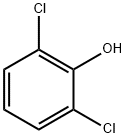
| Chemical Properties | 2,6-Dichlorophenol is a white crystalline solid having a strong odor similar to o-chlorophenol. Freely soluble in ethanol and ether, soluble in benzene and petroleum ether. | | Uses | 2,6-Dichlorophenol is produced as a by-product from the direct chlorination of phenol. It is used primarily as a starting material for the manufacture of trichlorophenols, tetrachlorophenols, and pentachlorophenols. It also acts as a sex pheromone for the Lone Star tick. | | Preparation | 2,6-Dichlorophenol has been prepared by the chlorination of phenol with chlorine gas in the presence of nitrobenzene and fuming sulfuric acid, by the decomposition of the diazotate of 2,6-dichloro-4-aminophenol, and by the decarboxylation of 3,5-dichloro-4-hydroxybenzoic acid in quinoline or dimethylaniline. | | Definition | ChEBI: 2,6-dichlorophenol is a dichlorophenol with the chloro substituents at positions 2 and 6. | | Synthesis Reference(s) | Journal of the American Chemical Society, 73, p. 2723, 1951 DOI: 10.1021/ja01150a084Organic Syntheses, Coll. Vol. 3, p. 267, 1955 | | General Description | 2,6-dichlorophenol is a white crystalline solid with a strong odor. Odor threshold concentration: 0.003 mg/L at 86°F; 200 micrograms/liter at 68-72°F. Taste threshold concentration: 0.0002 mg/L. (NTP, 1992) | | Air & Water Reactions | Insoluble in water. | | Reactivity Profile | 2,6-Dichlorophenol is incompatible with acid chlorides, acid anhydrides and oxidizing agents . | | Fire Hazard | Flash point data for 2,6-Dichlorophenol are not available; however, 2,6-Dichlorophenol is probably combustible. | | Safety Profile | Poison by
intraperitoneal route. Moderately toxic by
ingestion. A severe skin and eye irritant.
When heated to decomposition it emits
toxic fumes of Cl-. See also
CHLOROPHENOLS. | | Shipping | UN2020 Chlorophenols, solid, Hazard Class:
6.1; Labels: 6.1-Poisonous materials. | | Incompatibilities | Incompatible with oxidizers (chlorates,
nitrates, peroxides, permanganates, perchlorates, chlorine,
bromine, fluorine, etc.); contact may cause fires or explosions. Keep away from alkaline materials, strong bases,
strong acids, oxoacids, epoxides, acid fumes, acid anhyrides
and acid chlorides | | Waste Disposal | Dissolve in a combustible solvent and incinerate in a furnace equipped with afterburner
and scrubber. In accordance with 40CFR165, follow
recommendations for the disposal of pesticides and pesticide containers. Must be disposed properly by following
package label directions or by contacting your local or
federal environmental control agency, or by contacting
your regional EPA office. Consult with environmental
regulatory agencies for guidance on acceptable disposal
practices. Generators of waste containing this contaminant
(≥100 kg/mo) must conform with EPA regulations governing storage, transportation, treatment, and waste disposal |
| 2,6-Dichlorophenol Preparation Products And Raw materials |
| Raw materials | Chlorine-->Phenol-->Solvent-->2-Chlorophenol-->Ethylparaben-->2,4,6-Trichlorophenol-->IBHHIABVMOAELM-UHFFFAOYSA-N | | Preparation Products | 2,4-Dichlorophenol-->2,6-Dichloroindophenol sodium salt-->Triclosan-->Bithionol-->Diclofenac sodium-->Lofexidine-->2-(2,6-Dichlorophenoxy)ethylhydrazine-->2,6-DICHLORO-(2-CHLOROETHOXY)BENZENE-->Oxindole-->2,6-Dichloroaniline-->3',5'-DICHLORO-4'-HYDROXYACETOPHENONE-->1,2-DIBROMOHEXAFLUOROPROPANE-->2,6-DICHLORO-1,4-BENZOQUINONE-->3,5-DICHLORO-4-HYDROXYBENZALDEHYDE |
|


 日本语
日本语 한국어
한국어 Français
 Deutsch
 España
 Türkiye