Other grades of this product :
| L-Cysteine monohydrochloride Basic information |
| L-Cysteine monohydrochloride Chemical Properties |
| Melting point | 180°C | | alpha | 5.5 º (c=8, 6 N HCL) | | storage temp. | Inert atmosphere,Room Temperature | | solubility | H2O: 1 M at 20 °C, clear, colorless | | form | Solid | | color | White to light brown | | optical activity | [α]20/D +6.4±0.3°, c = 5% in 5 M HCl | | Water Solubility | SOLUBLE | | Sensitive | Hygroscopic | | Merck | 14,2781 | | BRN | 3560277 | | Stability: | Stable, but light, moisture and air sensitive. Incompatible with strong oxidizing agents, some metals. | | InChIKey | IFQSXNOEEPCSLW-DKWTVANSSA-N | | CAS DataBase Reference | 52-89-1(CAS DataBase Reference) | | NIST Chemistry Reference | L-cysteine hydrochloride(52-89-1) | | EPA Substance Registry System | L-Cysteine hydrochloride (52-89-1) |
| Hazard Codes | Xi | | Risk Statements | 36/37/38 | | Safety Statements | 26-36 | | WGK Germany | 2 | | RTECS | HA2275000 | | F | 3-10-23 | | TSCA | Yes | | HS Code | 29309013 | | Toxicity | LD50 intraperitoneal in mouse: 1250mg/kg |
| L-Cysteine monohydrochloride Usage And Synthesis |
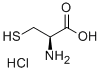
| Chemical Properties | solid | | Uses | As dough conditioner. | | Uses | L-Cysteine hydrochloride, anhydrous is widely used as additive in food production. It is used as an antioxidant to promote fermentation and keep the flavor. It is also used in cosmetics and animal feed. | | Definition | ChEBI: A hydrochloride obtained by combining L-cysteine with one molar equivalent of hydrogen chloride. | | General Description | L-cysteine is a sulfur-containing amino acid. | | Biochem/physiol Actions | NMDA glutamatergic receptor agonist that is also an agonist at AMPA glutamatergic receptors at high concentrations. | | Safety Profile | : Moderately toxic by
intraperitoneal, intravenous, and possibly
other routes. Mutation data reported. When
heated to decomposition it emits very toxic
fumes of NOx, SOx, and Cl-. | | Purification Methods | Likely impurities are cystine and tyrosine. Crystallise the salt from MeOH by adding diethyl ether, or from hot 20% HCl. Dry it under vacuum over P2O5. Hygroscopic. [Beilstein 4 III 1580, 1600.] |
| L-Cysteine monohydrochloride Preparation Products And Raw materials |
|


 日本语
日本语 한국어
한국어 Français
 Deutsch
 España
 Türkiye