Other grades of this product :
| PYRIDINE-2-CARBOXAMIDE Basic information |
| PYRIDINE-2-CARBOXAMIDE Chemical Properties |
| Melting point | 110 °C (dec.)(lit.) | | Boiling point | 143 °C / 20mmHg | | density | 1.2236 (rough estimate) | | refractive index | 1.5350 (estimate) | | storage temp. | Inert atmosphere,Room Temperature | | solubility | DMSO (Slightly), Methanol (Slightly) | | form | Solid | | pka | pK1: 2.10(+1) (20°C) | | color | White to Off-White | | BRN | 109617 | | CAS DataBase Reference | 1452-77-3(CAS DataBase Reference) | | EPA Substance Registry System | 2-Pyridinecarboxamide (1452-77-3) |
| Hazard Codes | Xi | | Risk Statements | 36/37/38 | | Safety Statements | 26-37/39 | | WGK Germany | 3 | | TSCA | Yes | | HS Code | 29333990 |
| PYRIDINE-2-CARBOXAMIDE Usage And Synthesis |
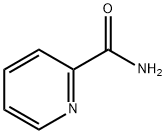
| Chemical Properties | White to off-white solid | | Uses | Picolinamide was used as template in preparation of molecular imprinting polymer. Picolinamide was used in a study to evaluate kinetics and mechanism of liberation of picolinamide from chromium(III)-picolinamide complexes in HClO4. | | Uses | A nicotinic acid derivative for prevention and treatment of cancer by activating RUNX3 gene. | | Definition | ChEBI: A pyridinecarboxamide that is the monocarboxylic acid amide derivative of picolinic acid. | | Biological Activity | picolinamide is a poly (adp-ribose) synthetase (parp) inhibitor.parp inhibitors, a group of pharmacological inhibitors of the enzyme poly adp ribose polymerase (parp), are developed for multiple indications, especially for the treatment of cancer. | | Biochem/physiol Actions | Picolinamide is potential inhibitor of poly (ADP-ribose) synthetase of nuclei from rat pancreatic islet cells. Picolinamide acts as bidentate ligand and forms complexes with lanthanide nitrates, thiocyanates and perchlorates. | | in vitro | the pathway of oxidation of picolinamide by a gram-negative rod has been elucidated. results showed that under high ph conditions, whole cells could release 2,5-dihydroxypyridine into culture supernatants. moreover, sodium arsenite was able to cause whole cells to accumulate 6-hydroxypicolinate in the culture media. in addition, whole cells were found to oxidize picolinamide, without lag. it was also found that cell-free extracts could convert picolinamide into picolinate, and hydroxylate picolinate into 6-hydroxypicolinate [1]. | | in vivo | picolinamide was used in a previous study to evaluate the possibility that the inhibition of na+/phosphate cotransport might be associated with the inhibition of nad hydrolyzing enzymes. results showed that the overnight treatment of rats with picolinamide, administered as a single injection (4 mmol/kg), could inhibit na+/phosphate cotransport by isolated renal brush border membrane vesicles. similar to nicotinamide, the inhibition caused by picolinamide occurred in thyroparathyroidectomized rats, was specific for na+/phosphate cotransport. unlike nicotinamide, there was only a small 1.5-fold increase in renal cortical nad content after picolinamide treatment [2]. | | references | [1] c. g. orpin,m. knight, and w. c. evans. the bacterial oxidation of picolinamide, a photolytic product of diquatbiochem j. 1972 may; 127(5): 819–831.[2] campbell pi, al-mahrouq ha,abraham mi,kempson sa. specific inhibition of rat renal na+/phosphate cotransport by picolinamide. j pharmacol exp ther.1989 oct;251(1):188-92. |
| PYRIDINE-2-CARBOXAMIDE Preparation Products And Raw materials |
|


 日本语
日本语 한국어
한국어 Français
 Deutsch
 España
 Türkiye