Other grades of this product :
| Benzyl thiocyanate Basic information |
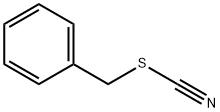
| Product Name: | Benzyl thiocyanate | | Synonyms: | alpha-Thiocyanatotoluene;BENZYL THIOCYANATE(SG);Beazyl thiocyanate;Benzyl thiocyanate, 98+%;a-Thiocyanatotoluene;Benzylrhodonid;Thiocyanatomethylbenzene;Troeolin | | CAS: | 3012-37-1 | | MF: | C8H7NS | | MW: | 149.21 | | EINECS: | 221-144-2 | | Product Categories: | | Mol File: | 3012-37-1.mol |
| Benzyl thiocyanate Chemical Properties |
| Hazard Codes | Xn | | Risk Statements | 20/21/22-32 | | Safety Statements | 13-36/37-50A | | RIDADR | UN 1759 8/PG 2 | | WGK Germany | 3 | | RTECS | XK8155000 | | TSCA | Yes | | HazardClass | 6.1 | | PackingGroup | III | | HS Code | 29309070 | | Toxicity | LDLo ipr-rat: 40 mg/kg ARZNAD 16,870,66ipr-mus LD50:17 mg/kg PCBPBS 2,95,72scu-mus LD50:100 mg/kg JJPAAZ 3,99,54 |
| Benzyl thiocyanate Usage And Synthesis |
| Description | Benzyl thiocyanate undergoes regioselective bond dissociation during its electrochemical reduction in acetonitrile at an inert electrode. It is added to stimulate the chlortetracycline biosynthesis during industrial fermentations. It undergoes biotransformation into dibenzyl disulphide by Streptomyces aureofaciens. | | Chemical Properties | ALMOST WHITE TO YELLOW CRYSTALS OR CRYST. POWDER | | Uses | Benzyl Thiocyanate is found to increase the protein production of Streptomyces aureofaciens. Inhibits methylazoxymethanol acetate-induced intestinal carcinogenesis and reduces unscheduled DNA synthesi
s for some genotoxic carcinogens in rats. | | Uses | Benzyl thiocyanate was used to study the effects of various dietary compounds on the α-hydroxylation of N-nitrosopyrrolidine in male F344 rats in vitro. | | Application | Benzyl thiocyanate was used to study the effects of various dietary compounds on the α-hydroxylation of N-nitrosopyrrolidine in male F344 rats in vitro. | | Synthesis Reference(s) | Synthesis, p. 184, 1977Tetrahedron Letters, 18, p. 4417, 1977 DOI: 10.1016/S0040-4039(01)83524-3 | | General Description | Benzyl thiocyanate undergoes regioselective bond dissociation during its electrochemical reduction in acetonitrile at an inert electrode. It is added to stimulate the chlortetracycline biosynthesis during industrial fermentations. It undergoes biotransformation into dibenzyl disulphide by Streptomyces aureofaciens. | | Hazard | Strong irritant to skin, tissue. Moderate fire hazard. | | Safety Profile | Poison by subcutaneous andintraperitoneal routes. Whenheated to decomposition it emits very toxic fumes ofNOx, SOx, and CN??. | | Purification Methods | Crystallise the thiocyanate from EtOH or aqueous EtOH. [Beilstein 6 H 460, 6 IV 2680.] |
| Benzyl thiocyanate Preparation Products And Raw materials |
|


 日本语
日本语 한국어
한국어 Français
 Deutsch
 España
 Türkiye