Other grades of this product :
| 1,4-Cyclohexanedione Basic information |
| 1,4-Cyclohexanedione Chemical Properties |
| Melting point | 77-78.5 °C (lit.) | | Boiling point | 112 °C (19.5026 mmHg) | | density | 1.0861 | | refractive index | 1.4570 (estimate) | | Fp | 132 °C | | storage temp. | Keep in dark place,Sealed in dry,Room Temperature | | solubility | Soluble in methanol and ethanol. | | form | Crystalline Powder or Flakes | | color | Light yellow to yellow or beige | | BRN | 774152 | | Stability: | Stable. Combustible. Incompatible with strong oxidizing agents. | | CAS DataBase Reference | 637-88-7(CAS DataBase Reference) | | NIST Chemistry Reference | 1,4-Cyclohexanedione(637-88-7) | | EPA Substance Registry System | 1,4-Cyclohexanedione (637-88-7) |
| Hazard Codes | Xi | | Safety Statements | 22-24/25 | | WGK Germany | 3 | | F | 8 | | Hazard Note | Irritant | | TSCA | Yes | | HS Code | 29142900 |
| 1,4-Cyclohexanedione Usage And Synthesis |
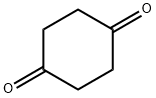
| Chemical Properties | tan or yellow crystalline powder | | Uses | 1,4-Cyclohexanedione is used in the preparation of 1,4 benzoquinone and bromoorganics. It is also used to study the influence of visible light on the bromate-1,4-cyclohexanedione-ferroin oscillating reaction. It plays a vital role in pharmaceuticals, plant growth regulator and as a conducting material. | | Definition | ChEBI: 1,4-Cyclohexanedione is a cyclohexanedione with oxo substituents at positions 1 and 4. | | Preparation | Synthesis of 1,4-cyclohexanedione: put diethyl succinylsuccinate into a flask, add a mixture of concentrated sulfuric acid, water and ethanol, reflux in oil solution for 5 days, cool, and neutralize to pH with ammonia water = 8; then extract 4 times with chloroform, and recover the chloroform to obtain the crude product; then the crude product is subjected to vacuum distillation, and the distillate is poured into cold petroleum ether, filtered, and air-dried to obtain 1,4-cyclohexanedi Ketone Products. | | Synthesis Reference(s) | Synthesis, p. 165, 1981 DOI: 10.1055/s-1981-29377 | | General Description | 1,4-Cyclohexanedione(CHD) undergoes uncatalyzed oscillatory reactions during oxidation by acidic bromate in nitric acid and sulphuric acid solution. It reacts with acidic bromate to form 1,4-dihydroxybenzene which on further oxidation and bromination yields 1,4-benzoquinone and bromoorganics. | | Pharmacology | The cyclohexanedione
(CHD) herbicides inhibit fatty acid synthesis
in plants by interfering with the activity of
the enzyme Acetyl-Coenzyme A Carboxylase (ACCase).
ACCase-inhibiting herbicides provide excellent control of
grass weeds in dicotyledonous and some grass crops. A
less-sensitive ACCase mediates the intrinsic resistance
of dicotyledonous plants to the AOPP and CHD herbicides
(34,35). Although grasses are target species of this
group of herbicides, not all are equally affected, and sensitivity
differences can occur between varieties or even
within a genus. |
| 1,4-Cyclohexanedione Preparation Products And Raw materials |
|


 日本语
日本语 한국어
한국어 Français
 Deutsch
 España
 Türkiye