Other grades of this product :
| Micafungin Chemical Properties |
| Melting point | >198oC (dec.) | | density | 1.62±0.1 g/cm3(Predicted) | | storage temp. | Hygroscopic, -20°C Freezer, Under inert atmosphere | | solubility | DMSO (Slightly), Methanol (Very Slightly, Heated) | | pka | -4.46±0.18(Predicted) | | form | Solid | | color | White to Off-White | | Stability: | Hygroscopic |
| Micafungin Usage And Synthesis |
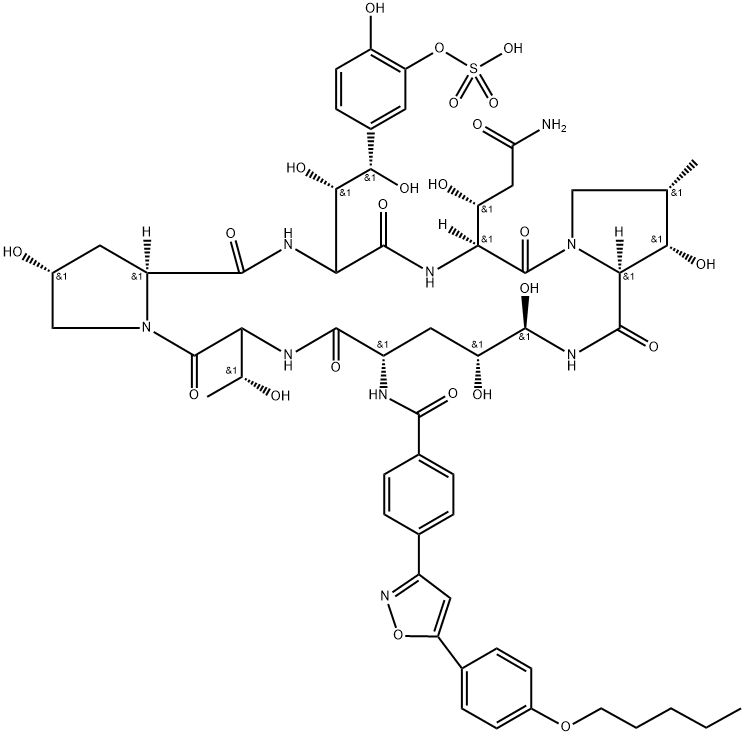
| Description | Micafungin (trade name Mycamine) is a kind of echinocandin antifungal drug. Its mechanism of action is through inhibiting the synthesis of beta-1, 3-glucan, which is an essential component of fungal cell walls, but not presented in mammalian cells. It works through inhibiting the beta-1,3-D glucan synthase. It can be used for the treatment of candidemia, acute disseminated candidiasis, candida peritonitis, abscesses and esophageal candidiasis. It is fungicidal against some candida, but fungistatic against Apergillus. It is also used in combinations with many other drugs such as the HIV protease inhibitor ritonavir as well as the transplant medications cyclosporine and tacrolimus.
| | References | https://www.drugbank.ca/drugs/DB01141
https://en.wikipedia.org/wiki/Micafungin
| | Description | Micafungin, the second
member of the echinocandin
class of antifungal agents was
launched in Japan for
the parenteral treatment of
various fungal infections caused
by Aspergillus and Candida spp.
such as fungaemia and
respiratory and gastrointestinal
mycoses. This water-soluble
semisynthetic cyclic lipopeptide is synthesized by acylation with (5-(4-
pentyloxyphenyl)isoxazol-3-yl)benzoate of the cyclic peptide nucleus (FR-179642).obtained by enzymatic cleavage of the naturally occurring echinocandin FR-901379,
derived from the fungus Coleophoma empedri Micafungin acts by inhibiting the synthesis
of 1,3-beta-glucan, an essential polysaccharide of the cell wall of many pathogenic fungi.
Micafungin has a marked fungicidal effect on almost all species of Candida, including
fluconazole-resistant spp. C. albicans, C. glabrata, C. Krusei, C. parapsilosis and C.
tropicalis and a fungistatic effect on a range of Aspergillus species including A. flaws, A.
fumigates and A. terreus. Like caspofungin, micafungin is inactive against Cryptococcus
neoformans, and the emerging pathogen Trichosporon cutaneum and Fusarium solani.
Micafungin has proved highly effective in mouse models of Cancfidiasis and Aspergillus
infections (including those using an amphotericin B- and itraconazole-resistant isolate of A.
fumigatus). In phase I studies, micafungin had linear pharmacokinetics with an elimination
half-life ranging from 11.7 to 15.2 h after injection and was well tolerated. | | Originator | Fujisawa (Japan) | | Uses | Micafungin is an antifungal drug that inhibits the production of β-1,3-glucan, an essential component of fungal cell walls. | | Uses | An echinocandin antifungal drug which inhibits the synthesis of 1,3-β-D-glucan, an essential component of the fungal cell wall, and represent a valuable treatment option for fungal infections. | | Uses | Micafungin is a semi-synthetic cyclic lipopeptide belonging to the echinocandin class that was reported in 1999 from Fujisawa in Japan. Unlike other marketed semi-synthetic derivatives in this class, micafungin is not derived from echinocandin but rather from FR901379 which contains a phenolic sulphate to enhance aqueous solubility, a serious limitation in the class. Micafungin inhibits the synthesis of β-(1,3)-D-glucan, an essential component of the cell wall of susceptible fungi and is extensively referenced in the literature with over 700 citations. | | Definition | ChEBI: A cyclic hexapeptide echinocandin antibiotic which exerts its effect by inhibiting the synthesis of 1,3-beta-D-glucan, an integral component of the fungal cell wall. It is used as the sodium salt for the treatment of invas
ve candidiasis, and of aspergillosis in patients who are intolerant of other therapy. | | Brand name | Mycamine(Astellas);Funguard. | | Antimicrobial activity | It is active against Aspergillus spp., Candida spp. and the cyst
form of Pn. jirovecii. Resistance has rarely been reported. | | Pharmaceutical Applications | A semisynthetic lipopeptide derived from a fermentation
product of Coleophoma empetri. Formulated as the monosodium
salt for intravenous infusion. | | Pharmacokinetics | Cmax 50 mg 1-h infusion: c. 5 mg/L 1 h post infusion
Plasma half-life: 11–15 h
Volume of distribution: 0.4 L/kg
Plasma protein binding: 99%
Blood concentrations increase in proportion to dosage. Unlike anidulafungin and caspofungin, a loading dose is not required.
Distribution
The drug is widely distributed, the highest concentrations being found in the liver. Levels in the CSF and urine are negligible.
Metabolism and excretion
It is metabolized by the liver and the three inactive metabolites are excreted in the feces (70%). Less than 1% of a dose is eliminated as unchanged drug in the urine. No dosage adjustment is required in patients with severe renal impairment or mild to moderate hepatic impairment. The effect of severe hepatic impairment on micafungin pharmacokinetics has not been studied. Micafungin is not cleared by hemodialysis. | | Clinical Use | Candidemia and certain invasive forms of candidosis
Esophageal candidosis
Prophylaxis of Candida infections in hematopoietic stem cell transplant
(HSCT) recipients | | Side effects | Occasional histamine-mediated infusion-related reactions,
injection site reactions and transient abnormalities of liver
enzymes have been reported. Isolated cases of significant
hepatic or renal dysfunction, hepatitis, or liver or renal failure
have also been described. | | Drug interactions | Potentially hazardous interactions with other drugs
Ciclosporin: possibly increases ciclosporin
concentration.
Sirolimus: increases sirolimus concentration. | | Metabolism | Metabolised in the liver by arylsulfatase to its catechol
form and further metabolised to the methoxy form by
catechol-O-methyltransferase. Some hydroxylation to
micafungin via cytochrome P450 isoenzymes also occurs.
Exposure to these metabolites is low and metabolites do
not contribute to the overall efficacy of micafungin.
After 28 days about 71% of a dose is recovered in the
faeces and 12% in the urine. |
| Micafungin Preparation Products And Raw materials |
|


 日本语
日本语 한국어
한국어 Français
 Deutsch
 España
 Türkiye