Other grades of this product :
| D(+)-Carvone Basic information |
| D(+)-Carvone Chemical Properties |
| Melting point | 88.9°C | | Boiling point | 96-98 °C/10 mmHg (lit.) | | alpha | 57 º (c=neat) | | density | 0.96 g/mL at 25 °C (lit.) | | vapor pressure | 20.665hPa at 25℃ | | FEMA | 2249 | CARVONE | | refractive index | n20/D 1.499 | | Fp | 204 °F | | storage temp. | Store below +30°C. | | solubility | 1300mg/l | | form | Liquid | | color | Clear colorless to pale yellow | | optical activity | [α]23/D +55.0±7°, neat | | Water Solubility | <0.1 g/100 mL at 25 ºC | | Merck | 14,1874 | | JECFA Number | 380 | | BRN | 2042970 | | Stability: | Stable. Combustible. Incompatible with strong oxidizing agents, strong reducing agents. | | LogP | 3.07 at 25℃ | | CAS DataBase Reference | 2244-16-8(CAS DataBase Reference) | | NIST Chemistry Reference | 2-Cyclohexen-1-one, 2-methyl-5-(1-methylethenyl)-, (S)-(2244-16-8) | | EPA Substance Registry System | D-Carvone (2244-16-8) |
| Hazard Codes | Xi | | Risk Statements | 22 | | Safety Statements | 24/25 | | RIDADR | 2810 | | WGK Germany | 1 | | RTECS | OS8670000 | | F | 8-9-23 | | Hazard Note | Irritant | | TSCA | Yes | | HazardClass | 6.1(a) | | PackingGroup | II | | HS Code | 29142900 | | Toxicity | LD50 oral in rat: 3710uL/kg |
| D(+)-Carvone Usage And Synthesis |
| Chemical Properties | colourless or pale yellow liquid | | Chemical Properties | Carvone is a pale yellow to white clear liquid. | | Chemical Properties | Caravone occurs in different forms. l-Carvone exhibits odor of spearmint, while d-carvone exhibits odor reminiscent
of caraway. | | Occurrence | The optically active and inactive forms have been reported among the constituents of about 70 essential oils.
The dextro form is present in carvi, Antheum graveolens, Antheum sowa, Lippia carviodora, Mentha arvensis, etc. The levo form is
present in Metha vifidis var. crispa, Mentha longifolia from South Africa, Eucalyptus globules and several mint species. The racemic
form is present in ginger grass, Litsea gutalemaleusis, lavender and Artemisia ferganensis. Reported found in citrus oil and juice
(lemon, lime, orange), celery seed, anise, clove, coriander seed, calamus, caraway herb and dill seed. | | Uses | (S)-(+)-Carvone can be used as a starting material to synthesize:- (-)-Samaderine Y, a pentacyclic quassinoid.
- (-)-Ambrox, a terpenoid responsible for the odor of ambergris.
- 3β-Acetoxydrimenin (a sesquiterpene) via conjugated addition of potassium cyanide followed by base catalyzed Robinson annulation reaction.
- Thapsigargin family members such as trilobolide, nortrilobolide, and thapsivillosin F.
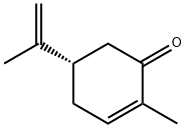
| | Definition | ChEBI: A carvone having (S) configuration. | | Aroma threshold values | Detection: d-Carvone: 6.7 to 820 ppb; l-carvone: 2.7 to 600 ppb | | General Description | Pale yellow or colorless liquid. | | Air & Water Reactions | May be sensitive to prolonged exposure to light and air. Insoluble in water. | | Reactivity Profile | D(+)-Carvone may be sensitive to prolonged exposure to light and air. Incompatible with strong oxidizing agents and strong reducing agents | | Fire Hazard | D(+)-Carvone is combustible. | | Flammability and Explosibility | Notclassified | | Safety Profile | Poison by ingestion and
skin contact. A skin irritant. When heated to
decomposition it emits acrid smoke and
irritating fumes. | | Synthesis | Carvone occurs in the dextro, levo and racemic form; l-carvone can be isolated from the essential oil of spearmint or
is commercially synthesized from d-limonene; d-carvone is usually prepared by fractional distillation of oil of caraway, also from
dillseed and dillweed oils, but this type differs in odor and flavors. | | Potential Exposure | Carvone is found in various natural
oils, including caraway and dillseed; mandarin peel and
spearmint oils. A food additive, it is used in flavoring
liqueurs; in perfumes and soaps. | | Shipping | UN2810 Toxic liquids, organic, n.o.s., Hazard
Class: 6.1; Labels: 6.1-Poisonous materials, Technical
Name Required | | Incompatibilities | Incompatible with oxidizers (chlorates,
nitrates, peroxides, permanganates, perchlorates, chlorine,
bromine, fluorine, etc.); contact may cause fires or explosions. Keep away from alkaline materials, strong bases,
strong acids, oxoacids, epoxides. |
| D(+)-Carvone Preparation Products And Raw materials |
|

 日本语
日本语 한국어
한국어 Français
 Deutsch
 España
 Türkiye