Other grades of this product :
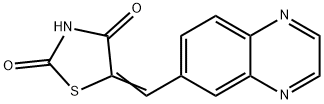
| 5-(6-Quinoxalinylmethylene)-2,4-thiazolidinedione Basic information |
| 5-(6-Quinoxalinylmethylene)-2,4-thiazolidinedione Chemical Properties |
| density | 1.553±0.06 g/cm3(Predicted) | | storage temp. | 2-8°C | | solubility | DMSO: soluble1mg/mL, clear (warmed) | | pka | 6.02±0.20(Predicted) | | form | powder | | color | , faint red to orange to dark brown |
| Hazard Codes | Xi | | Risk Statements | 36/37/38 | | Safety Statements | 26 | | WGK Germany | 3 | | HS Code | 2934100090 |
| 5-(6-Quinoxalinylmethylene)-2,4-thiazolidinedione Usage And Synthesis |
| Uses | AS605240 has been used:- as a phosphatidylinositol 3-kinase (PI3K) inhibitor to study its effect on Rab5-positive early endosome (EE) vesicles.
- as a (PI3K) inhibitor to treat splenocytes for graft-versus-host disease (GVHD) induction.
- as a class 1A PI3K inhibitor?to treat CD4+?T cells.
| | Biological Activity | Potent and selective inhibitor of PI 3-kinase γ (PI3K γ ) (IC 50 = 8 nM). Displays 30-fold selectivity over PI3K δ and PI3K β and 7.5-fold selectivity over PI3K α . Suppresses the progression of joint inflammation and damage in both lymphocyte-independent and lymphocyte-dependent mouse models of rheumatoid arthritis. Orally active and ATP-competitive. | | Biochem/physiol Actions | AS605240 inhibits human recombinant phosphatidylinositol 3-kinase (PI3K) γ, α, β, and δ by competing with adenosine triphosphate (ATP). It plays a role in protecting injury following ischemic stroke. AS605240 also inhibits the activation of astrocytes under the influence of Interleukin-6 (IL-6) and its soluble receptor (sIL-6R). It reduces collagen deposition and prevents lung inflammation. AS605240 also inhibits the increase of tumor necrosis factor-α (TNF-α) and interleukin-1β (IL-1β) expression instigated by bleomycin. It is effective in preventing pulmonary fibrosis by inhibiting the transforming growth factor β1 (TGF-β1) and T lymphocytes infiltration into lungs. | | references | [1]. camps m, rückle t, ji h, et al. blockade of pi3kγ suppresses joint inflammation and damage in mouse models of rheumatoid arthritis[j]. nature medicine, 2005, 11(9): 936-943.[2]. marone r, cmiljanovic v, giese b, et al. targeting phosphoinositide 3-kinase—moving towards therapy[j]. biochimica et biophysica acta (bba)-proteins and proteomics, 2008, 1784(1): 159-185. |
| 5-(6-Quinoxalinylmethylene)-2,4-thiazolidinedione Preparation Products And Raw materials |
|


 日本语
日本语 한국어
한국어 Français
 Deutsch
 España
 Türkiye