Other grades of this product :
| trans-Cinnamic acid Basic information |
| trans-Cinnamic acid Chemical Properties |
| Melting point | 133 °C (lit.) | | Boiling point | 300 °C(lit.) | | density | 1.248 | | vapor pressure | 1.3 hPa (128 °C) | | refractive index | 1.5049 (estimate) | | Fp | >230 °F | | storage temp. | 2-8°C | | solubility | 0.4g/l | | pka | 4.44(at 25℃) | | form | Crystalline Powder | | color | White to almost white | | Specific Gravity | 0.91 | | Odor | Faint odour | | PH Range | 3 - 4 | | PH | 3-4 (0.4g/l, H2O, 20℃) | | Water Solubility | 0.4 g/L (20 ºC) | | λmax | 273nm(MeOH)(lit.) | | Merck | 14,2299 | | BRN | 1905952 | | InChIKey | WBYWAXJHAXSJNI-VOTSOKGWSA-N | | CAS DataBase Reference | 140-10-3(CAS DataBase Reference) | | NIST Chemistry Reference | Cinnamic acid(140-10-3) | | EPA Substance Registry System | (E)-Cinnamic acid (140-10-3) |
| Hazard Codes | Xi | | Risk Statements | 36/37/38 | | Safety Statements | 26-36-37/39 | | WGK Germany | 1 | | RTECS | GD7850000 | | TSCA | Yes | | HS Code | 29163900 | | Toxicity | LD50 orally in Rabbit: 2500 mg/kg LD50 dermal Rabbit > 5000 mg/kg |
| trans-Cinnamic acid Usage And Synthesis |
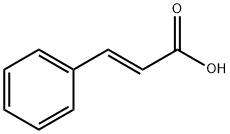
| Chemical Properties | White to almost white crystalline powder. Insoluble in water, slightly soluble in hot water, easily soluble in benzene, acetone, ether, glacial acetic acid and other organic solvents. | | Uses | trans-Cinnamic acid is used in flavors, synthetic indigo and pharmaceuticals. It is involved in the production of methyl, ethyl and benzyl esters, which is used in the perfume industry. It serves as a precursor to the sweetener aspartame through enzyme-catalyzed amination to phenylalanine. It is a self-inhibitor produced by fungal spores to prevent germination. In addition, it is used to establish phenolic compounds by liquid chromatography, ultraviolet and mass spectrometry. It is utilized as a potential agent, thereby preventing lung tumor cells from metastasizing. Further, it induces intracellular release of calcium ions from the vacuole to the cytoplasm in order to trigger phytotoxicity in cucumber. | | Uses | trans-Cinnamic acid was used to establish library of phenolic compounds by liquid chromatography/ultraviolet and mass spectrometry/mass spectrometry. | | Definition | ChEBI: Cinnamic acid is a monocarboxylic acid that consists of acrylic acid bearing a phenyl substituent at the 3-position. It is found in Cinnamomum cassia. It has a role as a plant metabolite. It is a member of styrenes and a member of cinnamic acids. It is a conjugate acid of a cinnamate. | | General Description | trans-Cinnamic acid is an α,β-unsaturated aromatic acid that can be used as a flavoring agent. It is mainly used to prepare ester derivatives that are used in perfume industry. trans-Cinnamic acid is the key volatile components of cinnamon essential oil. | | Flammability and Explosibility | Notclassified | | Biochem/physiol Actions | trans-cinnamic acid has inhibitory effect on phorbol-12-myristate-13-acetate-induced invasion of human lung adenocarcinoma A549 cells. It is a potential agent which can prevent lung tumor cells from metastasizing. It induces intracellular release of Ca2+ from the vacuole to the cytoplasm which triggers phytotoxicity in cucumber. | | Purification Methods | Crystallise the acid from *benzene, CCl4, hot water, water/EtOH (3:1), or 20% aqueous EtOH. Dry it at 60o in vacuo. It is steam volatile. [Beilstein 9 IV 2002.] |
| trans-Cinnamic acid Preparation Products And Raw materials |
|


 日本语
日本语 한국어
한국어 Français
 Deutsch
 España
 Türkiye