Other grades of this product :
| Fludarabine phosphate Basic information |
| Fludarabine phosphate Chemical Properties |
| Melting point | 203°C(dec.)(lit.) | | alpha | [α]D20 +10~+14゜(c=0.5,H2O) | | Boiling point | 864.2±75.0 °C(Predicted) | | density | 2.39±0.1 g/cm3(Predicted) | | RTECS | UO7440900 | | storage temp. | 2-8°C | | solubility | DMSO: soluble1mg/mL | | form | Powder | | pka | 1.86±0.10(Predicted) | | color | white | | Water Solubility | Soluble in DMSO or water at 5mg/ml | | Merck | 14,4126 | | Stability: | Hygroscopic | | InChIKey | GIUYCYHIANZCFB-GFRUICAKSA-N | | CAS DataBase Reference | 75607-67-9(CAS DataBase Reference) |
| WGK Germany | 3 | | HS Code | 2934990002 |
| Fludarabine phosphate Usage And Synthesis |
| Description | Fludarabine phosphate is an antimetabolite indicated for the treatment of B cell
lymphocytic leukemia. It is reportedly effective in patients refractory to other
therapies. Fludarabine phosphate acts by inhibiting primer RNA synthesis. Its side
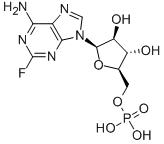
effects include bone marrow suppression, anemia, thrombocytopenia and neutropenia. | | Chemical Properties | White or almost white, crystalline powder, hygroscopic. | | Originator | Southern Research Institute (U.S.A.) | | Uses | anticonvulsant | | Uses | Fludarabine phosphate is used for the treatment of chronic lymphatic leukemia and low-grade lymphoma. In the circulation,fludarabine phosphate is immediately dephosphorylated to the nucleoside fludarabine. About 30-40% of nucleoside fludarabine is excreted into the urine. In addition, fludarabine is metabolized into a hypoxanthine metabolite also excreted in the urine.Intracellularly,fludarabine is stepwise rephosphorylated to the active triphosphate. Deoxycytidine kinase is the dominant, if not the exclusive,enzyme for the formation of the monophosphate. Adenylate kinase and nucleoside diphosphate kinase are believed to be involved in the formation of the diphosphate and triphosphate,respectively. | | Definition | ChEBI: Fludarabine phosphate is a purine arabinonucleoside monophosphate having 2-fluoroadenine as the nucleobase. A prodrug, it is rapidly dephosphorylated to 2-fluoro-ara-A and then phosphorylated intracellularly by deoxycytidine kinase to the active triphosphate, 2-fluoro-ara-ATP. Once incorporated into DNA, 2-fluoro-ara-ATP functions as a DNA chain terminator. It is used for the treatment of adult patients with B-cell chronic lymphocytic leukemia (CLL) who have not responded to, or whose disease has progressed during, treatment with at least one standard alkylating-agent containing regimenas. It has a role as an antimetabolite, an antineoplastic agent, an immunosuppressive agent, an antiviral agent, a prodrug and a DNA synthesis inhibitor. It is an organofluorine compound, a nucleoside analogue and a purine arabinonucleoside monophosphate. It derives from a 2-fluoroadenine. | | Brand name | Fludara (Berlex). | | Pharmacology | Fludarabine phosphate is rapidly dephosphorylated to 2-fluoro-ara-A and then phosphorylated intracellularly by deoxycytidine kinase to the active triphosphate, 2-fluoro-ara-ATP. This metabolite appears to act by inhibiting DNA polymerase alpha, ribonucleotide reductase and DNA primase, thus inhibiting DNA synthesis. The mechanism of action of this antimetabolite is not completely characterized and may be multi-faceted.
Phase I studies in humans have demonstrated that fludarabine phosphate is rapidly converted to the active metabolite, 2-fluoro-ara-A, within minutes after intravenous infusion.
Consequently, clinical pharmacology studies have focused on 2-fluoro-ara-A pharmacokinetics. After the five daily doses of 25 mg 2-fluoro-ara-AMP/m2 to cancer patients infused over 30 minutes, 2-fluoro-ara-A concentrations show a moderate accumulation. During a 5-day treatment schedule, 2-fluoro-ara-A plasma trough levels increased by a factor of about 2. The terminal half-life of 2-fluoro-ara-A was estimated as approximately 20 hours. In vitro, plasma protein binding of fludarabine ranged between 19% and 29%. | | Clinical Use | Fludarabine phosphate (Fludara ® ), is a fluorinated nucleotide analog of the antiviral agent vidarabine, 9-β-D-arabinofuranosyladenine(ara-A), which differs only by the presence of a fluorine atom at position 2 of the purine moiety and a phosphate group at position 5 of the arabinose moiety (Plunkett et al., 1993). These structural modifications result in increased aqueous solubility and resistance to enzymatic degradation by adenosine deaminases compared to vidarabine (Brockman et al., 1977; Plunkett et al., 1990). Fludarabine phosphate is indicated for the treatment of patients with B-cell chronic lymphocytic leukemia (CLL) who have not responded to or whose disease has progressed during treatment with at least one standard alkylating agent containing regimen (Boogaerts et al., 2001; Rossi et al., 2004). | | Drug interactions | Potentially hazardous interactions with other drugs
Antipsychotics: avoid concomitant use with
clozapine, increased risk of agranulocytosis.
Cytotoxics: increased pulmonary toxicity with
pentostatin (unacceptably high incidence of
fatalities); increases intracellular concentration of
cytarabine. | | Metabolism | Intravenous fludarabine phosphate is rapidly
dephosphorylated to fludarabine which is taken up
by lymphocytes and rephosphorylated via the enzyme
deoxycytidine kinase to the active triphosphate
nucleotide. Clearance of fludarabine from the plasma
is triphasic; elimination is mostly via renal excretion:
40-60% of an intravenous dose is excreted in the urine.
The pharmacokinetics of fludarabine show considerable
inter-individual variation |
| Fludarabine phosphate Preparation Products And Raw materials |
|


 日本语
日本语 한국어
한국어 Français
 Deutsch
 España
 Türkiye