Other grades of this product :
| 6-Ethyl-3-oxa-6-azaoctanol Basic information |
| 6-Ethyl-3-oxa-6-azaoctanol Chemical Properties |
| 6-Ethyl-3-oxa-6-azaoctanol Usage And Synthesis |
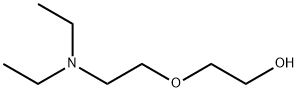
| Chemical Properties | Pale Yellow Oil | | Uses | A metabolite of Butamirate; also a degradation product of Oxeladin citrate (OL) and Oxybutynin hydrochloride (OB). | | General Description | A colorless liquid with an amine-like odor. Slightly less dense than water and slightly soluble in water. Flash point below 141°F. May emit toxic oxides of nitrogen when heated to high temperatures May cause irritate the skin, eyes, and mucous membranes. May be toxic by ingestion. Used to make other chemicals. | | Air & Water Reactions | Highly flammable. Slightly soluble in water. | | Reactivity Profile | 6-Ethyl-3-oxa-6-azaoctanol is an amine and alcohol. Amines are chemical bases. They neutralize acids to form salts plus water. These acid-base reactions are exothermic. The amount of heat that is evolved per mole of amine in a neutralization is largely independent of the strength of the amine as a base. Amines may be incompatible with isocyanates, halogenated organics, peroxides, phenols (acidic), epoxides, anhydrides, and acid halides. Flammable gaseous hydrogen is generated by amines in combination with strong reducing agents, such as hydrides. | | Health Hazard | Inhalation or contact with material may irritate or burn skin and eyes. Fire may produce irritating, corrosive and/or toxic gases. Vapors may cause dizziness or suffocation. Runoff from fire control may cause pollution. | | Fire Hazard | HIGHLY FLAMMABLE: Will be easily ignited by heat, sparks or flames. Vapors may form explosive mixtures with air. Vapors may travel to source of ignition and flash back. Most vapors are heavier than air. They will spread along ground and collect in low or confined areas (sewers, basements, tanks). Vapor explosion hazard indoors, outdoors or in sewers. Runoff to sewer may create fire or explosion hazard. Containers may explode when heated. Many liquids are lighter than water. | | Safety Profile | A poison by ingestion
and skin contact. A severe eye and mdd skin
irritant. When heated to decomposition it
emits toxic vapors of NOx. |
| 6-Ethyl-3-oxa-6-azaoctanol Preparation Products And Raw materials |
|


 日本语
日本语 한국어
한국어 Français
 Deutsch
 España
 Türkiye