Other grades of this product :
| Ioversol Chemical Properties |
| Melting point | 180-182°C | | Boiling point | 864.9±65.0 °C(Predicted) | | density | d37 1.371 (c = 320 mgI/ml) | | storage temp. | Refrigerator | | solubility | DMSO (Sparingly), Methanol (Slightly) | | pka | 11.34±0.46(Predicted) | | form | Solid | | color | White to Off-White | | CAS DataBase Reference | 87771-40-2(CAS DataBase Reference) |
| HS Code | 2924296000 | | Toxicity | LD50 in mice, rats, rabbits, dogs (gI/kg): 17, 15, >25, >12 i.v.; in male, female rats (mgI/kg): 1000, >1200 intracisternally (Ralston) |
| Ioversol Usage And Synthesis |
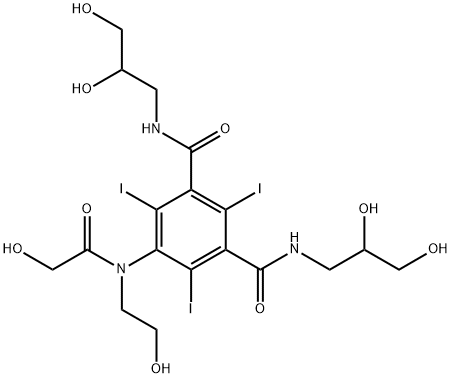
| Description | Loversol is a kind of organioiodine compound that used as a contrast
medium. It has high iodine content as well as several hydrophilic
groups. It can be used for peripheral and coronary arteriography and
left ventriculograpy, cardiovascular system angiography, cerebral
angiography, venography, tomographic imaging of the head and body as
well as intravenous excretory urography. It takes effects through
opacifying those vessels in the path of the flow of the contrast
medium, permitting radiographic visualization of the internal
structure. | | References | http://www.rxlist.com/optiray-injection-drug.htm
https://www.drugbank.ca/drugs/DB09134
| | Chemical Properties | White Solid | | Uses | Loversol is a radiopaque contrast agent. Ioversol contains iodine, a substance that absorbs x-rays. Contrast agents are used to allow blood vessels, organs, and other non-bony tissues to be seen more clearly on a CT scan or other radiologic (x-ray) examination. | | Uses | Nonionic, low osmolality, radiographic contrast agent. Diagnostic aid (radiopaque medium). | | Definition | Loversol is classified as an organoiodine compound and is used as a contrast dye in diagnostic procedures. It contains high levels of iodine in addition to various hydrophilic groups. | | Brand name | Optiray (Mallinckrodt). | | General Description | Ioversol is a low-osmolar, nonionicmonomer with 47% bound iodine content. It is indicated forangiography, excretory urography, ventriculography, andvarious CT procedures. | | Side effects | The most common reaction is nausea, occurring at a rate of 1 percent.Serious adverse reactions have been reported during post-approval use of Optiray. These serious adverse reactions include but are not limited to: anaphylactic reactions, arrhythmias, temporary blindness, tongue edema, seizures, respiratory arrest, bronchospasm, laryngeal spasm and thrombosis. |
| Ioversol Preparation Products And Raw materials |
| Raw materials | 5-[2-chloro-N-(2-hydroxyethyl)acetamido]-N1,N3-bis(2,3-dihydroxypropyl)-2,4,6-triiodobenzene-1,3-dicarboxamide-->5-Amino-N,N'-bis(2,3-dihydroxypropyl)-2,4,6-triiodo-1,3-benzenedicarboxamide-->N-DesMethyl IoMeprol-->5 - chloro-acetamido-N, N - bis (2,3 - dihydroxypropyl) -2,4,6 - triiodo-1 ,3. Phthalimido-->5-[[2-(Acetyloxy)acetyl]amino]-2,4,6-triiodo-1,3-benzenedicarbonyl Dichloride |
|


 日本语
日本语 한국어
한국어 Français
 Deutsch
 España
 Türkiye