Other grades of this product :
| TAXIFOLIN 3-O-RHAMNOSIDE Basic information |
| TAXIFOLIN 3-O-RHAMNOSIDE Chemical Properties |
| Melting point | 180 °C (decomp) | | Boiling point | 801.1±65.0 °C(Predicted) | | density | 1.74 | | storage temp. | Sealed in dry,2-8°C | | solubility | H2O: soluble1mg/mL, clear, colorless | | pka | 7.34±0.60(Predicted) |
| Hazard Codes | N | | Risk Statements | 50 | | Safety Statements | 61 | | RIDADR | UN 3077 9 / PGIII | | WGK Germany | 3 | | HS Code | 29389090 |
| TAXIFOLIN 3-O-RHAMNOSIDE Usage And Synthesis |
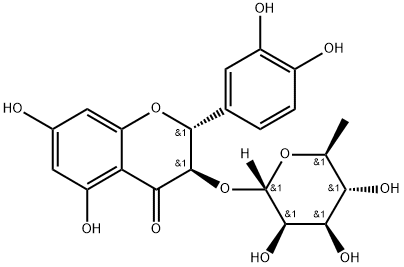
| Description | Astilbin is a flavonoid that has been found in S. glabra and has diverse biological activities. It inhibits cisplatin-induced increases in apoptosis and accumulation of reactive oxygen species (ROS) in HEK293 cells when used at a concentration of 200 μM. Astilbin (50 mg/kg) increases renal glutathione (GSH) levels and superoxide dismutase (SOD) and catalase activity and reduces serum creatinine and blood urea nitrogen (BUN) levels, renal IL-1β, IL-6, and TNF-α levels, apoptosis in kidney tissue, and kidney injury in a mouse model of cisplatin-induced nephrotoxicity. It reduces loss of dopaminergic neurons in the substantia nigra and increases striatal GSH levels and SOD activity in a mouse model of MPTP-induced Parkinson''s disease when administered at a dose of 50 mg/kg per day. Astilbin also reduces descent time in a pole test and increases traction test score in a mouse model of Parkinson''s disease, indicating reduced motor deficits. It reduces cell viability of MDA-MB-231 and MCF-7 cells (IC50s = 167.9 and 191.6 μM, respectively), as well as inhibits migration and increases apoptosis when used at concentrations of 50 and 200 μM. Astilbin (20 mg/kg every other day for 14 days) reduces tumor growth in an MCF-7 mouse xenograft model. | | Uses | Astilbin displays anti-depressant activity involving monoaminergic neurotransmitters an the BDNF signal pathway. Anti-oxidant. | | Definition | ChEBI: A flavanone glycoside that is (+)-taxifolin substituted by a alpha-L-rhamnosyl moiety at position 3 via a glycosidic linkage. |
| TAXIFOLIN 3-O-RHAMNOSIDE Preparation Products And Raw materials |
|


 日本语
日本语 한국어
한국어 Français
 Deutsch
 España
 Türkiye