Other grades of this product :
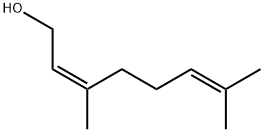
| Product Name: | NEROL | | Synonyms: | (3Z)-3,7-Dimethyl-2,6-octadiene-1-ol;NEROL EXTRA LG FCC;NEROL PRIME;NEROL, NATURAL;cis-3,7-Dimethyl-2,6-octadien-1-ol, Nerol;Nerol,97%;Nerol,cis-3,7-Dimethyl-2,6-octadien-1-ol;cis-3,7-Dimethyl-2,6-octadien-1-ol,cis-3,7-Dimethyl-2,6-octadien-1-ol, Nerol | | CAS: | 106-25-2 | | MF: | C10H18O | | MW: | 154.25 | | EINECS: | 203-378-7 | | Product Categories: | Acyclic;Alkenes;Artemisia vulgaris;Building Blocks;Chemical Synthesis;Citrus aurantium (Seville orange);Elettaria Cardamomum (Cardamom);Humulus lupulus (Hops);Lavandula angustifolia (Lavendar tea);Melaleuca alternifolia;Nutrition Research;Ocimum basilicum (Basil);Organic Building Blocks;Phytochemicals by Plant (Food/Spice/Herb);Acyclic Monoterpenes;Biochemistry;Terpenes;s wort);Sambucus nigra (Elderberry);Vaccinium myrtillus (Bilberry);Zingiber officinale (Ginger) | | Mol File: | 106-25-2.mol |
| NEROL Chemical Properties |
| Melting point | | Boiling point | 103-105 °C/9 mmHg (lit.) | | density | 0.876 g/mL at 25 °C (lit.) | | vapor pressure | 2.39Pa at 20℃ | | FEMA | 2770 | NEROL | | refractive index | n20/D 1.474(lit.) | | Fp | 226 °F | | storage temp. | 2-8°C | | solubility | absolute ethanol: soluble(lit.) | | form | Liquid | | pka | 14.45±0.10(Predicted) | | color | Clear colorless to almost colorless | | Water Solubility | 1.311g/L(25 ºC) | | Merck | 14,6475 | | JECFA Number | 1224 | | BRN | 1722455 | | LogP | 2.76 at 30℃ | | CAS DataBase Reference | 106-25-2(CAS DataBase Reference) | | EPA Substance Registry System | 2,6-Octadien-1-ol, 3,7-dimethyl-, (2Z)- (106-25-2) |
| Hazard Codes | Xi | | Risk Statements | 36/37/38 | | Safety Statements | 26-36 | | RIDADR | UN1230 - class 3 - PG 2 - Methanol, solution | | WGK Germany | 2 | | RTECS | RG5840000 | | TSCA | Yes | | HS Code | 29052210 | | Hazardous Substances Data | 106-25-2(Hazardous Substances Data) | | toxicity | The acute oral LD50 value in rats was reported as 4.5 g/kg (3.4-5.6 g/kg) (Moreno, 1972). The acute dermal LD50 value in rabbits exceeded 5 g/kg (Moreno, 1972). |
| NEROL Usage And Synthesis |
| Identification test | Determination of total alcohol (OT-5). The amount of sample taken is 1.2g; the equivalent factor (e) in the calculation is 77.13. | | Chemical properties | Colorless oily liquid It bears a sweet smell similar to the fresh rose, better than geraniol, and with hints of lemon flavor. The boiling point is 227 ℃; flash point is 92 ℃; optical rotation is [α] D ± 0 °. Miscible in ethanol, chloroform and ether; nearly insoluble in water.
It is the isomer of geraniol (trans; geraniol is cis).
Natural lanolin and its esters are found in orange leaf oil, rose oil, lavender oil, Sri Lanka citronella oil, bitter orange blossom oil and bergamot, lemon, white lemon, grapefruit, sweet orange and so on. | | Uses | The food flavors are mainly for the preparation of raspberry, strawberry and citrus fruit flavors and preparation of orange blossom, rose, magnolia main spices. It is a spice commonly used in jasmine, white flowers, lilac, lily of the valley, narcissus, carnation, mimosa, violet, vanilla, cymbidium, tuberose and citrus cologne. It is also commonly used in hyacinth, gardenia, osmanthus, acacia flavor formula. In the food flavor, its raspberry-strawberry flavor effect is commonly used. The product is also used in the preparation of daily makeup fragrance, such as violet, orange blossom, jasmine, lily of the valley, magnolia, cloves and other fragrance type makeup fragrance. It is widely used in orange blossom, rose, jasmine, tuberose and other fragrances of fragrant type and food flavor of raspberry, strawberry. It can also be used to produce ester spices. | | Preparation | 1. Oil of petitgrain is used as raw material; the first step is eliminating linalool and terpenes through fractionation; through saponification the fraction containing primary alcohol will be made into phthalate esters; and then going through purification and alkali saponification, geraniol (60 %) and nerol (40%) mixture is derived; removing geraniol with lead chloride, undergoing the residue vacuum distillation or steam distillation, the product was derived.
2. Let the geraniol and hydroiodic acid reacted in the neutral solution. Removing excess hydrogen iodide with alkali, the nerol mixed with geraniol can be derived, and then separate the mixture using the above method.
3. Heat the mixture of the same amount of camphor and acetic anhydride to boiling in the presence of sodium acetate. The mixture of geraniol and neryl alcohol can be derived through saponified esterification, and then separate the mixture by the former method.
4. Reducing citral in the isopropanol solution containing isopropanol aluminium also can obtain the mixture of geraniol and nerol, and nerol is derived through re-separation. | | Toxicity | GRAS (FEMA).
LD504500 mg/kg (rat, oral).
maximum level FEMA (mg/kg): soft drink 1.4; cold drink 3.9; candy 16; baked food 19; pudding 1.0 to 1.3;
utilization limitation (FDA $ 172. 515, 2000). | | Description | Nerol has a fresh, sweet, rose-like odor and a bitter flavor. Nerol may be synthesized from pinene. | | Chemical Properties | Nerol has a fresh, sweet, rose-like odor and a bitter flavor. | | Chemical Properties | Clear colorless to almost colorless liquid | | Chemical Properties | Nerol occurs in small
quantities in many essential oils where it is always accompanied by geraniol; its
name originates from its occurrence in neroli oil. Nerol is a colorless liquid with a
pleasant rose-like odor, which, unlike that of geraniol, has a fresh green note.
Nerol undergoes the same reactions as geraniol but cyclizes more readily in the
presence of acids.
Nerol is produced along with geraniol from myrcene in the process described
for geraniol. It can be separated from geraniol by fractional distillation.
Nerol is used in perfumery not only for the same purposes as geraniol,
for example, in rose compositions, to which it lends a particular freshness, but
also in other blossom compositions. In flavor work, it is used for bouquetting citrus
flavors. Technical-grade nerol, often in a mixture with geraniol, is used as an
intermediate in the production of citronellol and citral. | | Occurrence | Reported found in neroli oil (with geraniol) and in the essential oils of lemongrass, Ceylon citronella, ylangylang, champaca, Cayenne Bois de Rose and bergamot; also in lemon, sweet orange and petitgrain bergamot; in clary sage, lavandin,
lavender, Mexican linaloe, myrrh, jasmine, Paraguay petitgrain; also reported among the volatile constituents of currant aroma;
Helicrysum angustifolium contains up to 30 to 50% nerol. Also reported found in citrus peel oils and juices, apricot, cranberry,
blueberry, currant, grapes, papaya, raspberry, blackberry, strawberry, potato, tomato, cinnamon, ginger, mentha oils, mustard, nutmeg, thyme, hop oil, beer, gin, cognac, brandy, grape wines, tea, honey, Arctic bramble, passion fruit, prune, Japanese plum, rose
apple, marjoram, mango, tamarind, cardamom, coriander seed and leaf, tarragon, litchi, licorice, buckwheat, laurel, wort, elderberry,
cherimoya, myrtle leaf and berry, buchu oil, Bourbon vanilla, lemon balm, clary sage, loganberry, maté, German chamomile oil and
mastic gum leaf oil. | | Uses | Nerol is a flavoring agent that is a colorless liquid with an odor resem-
bling fresh, sweet roses and contains geranoils and other terpenic
alcohols. it is miscible in alcohol, chloroform, and ether insoluble
in water. it is obtained by synthesis. it is also termed cis-3,7-dime-
thyl-2,6-octadien-1-ol. | | Uses | Nerol is an isomer of Geraniol (G367000), used in the synthesis of insect repellant. It is also used in the synthesis of Angelicoin A and Herecinone J, which inhibit collagen-induced platelet aggregat
ion. | | Uses | nerol is a primary alcohol used in perfumes, especially those with rose and orange blossom scents. nerol is a naturally occurring fraction in oil of lavender, orange leaf, palmarosa, rose, neroli, and petitgrain. It is colorless and has a rose-like scent. | | Definition | ChEBI: The (2Z)-stereoisomer of 3,7-dimethylocta-2,6-dien-1-ol. It has been isolated from the essential oils from plants like lemon grass. | | Preparation | From pinene. | | Aroma threshold values | Detection: 680 ppb to 2.2 ppm; aroma characteristics at 2%: rosy, slightly citrus, terpy and floral, reminiscent of linalool oxide with aldehydic waxy and fruity nuances | | Taste threshold values | Taste characteristics at 10 ppm in 5% sugar and 0.1% CA: rosy with citrus nuances, fruity pear with floral
citronellal notes | | Synthesis Reference(s) | Tetrahedron, 40, p. 641, 1984 DOI: 10.1016/S0040-4020(01)91092-0Tetrahedron Letters, 33, p. 5417, 1992 DOI: 10.1016/S0040-4039(00)79109-XSynthesis, p. 328, 1988 DOI: 10.1055/s-1988-27559 | | General Description | The antifungal efficacy of nerol (cis-3,7-Dimethyl-2,6-octadien-1-ol), against Aspergillus flavus, was studied. | | Safety Profile | Moderately toxic by
intramuscular route. Mildly toxic by
ingestion. A skin irritant. When heated to
decomposition it emits acrid smoke and
irritating fumes. |
| NEROL Preparation Products And Raw materials |
|


 日本语
日本语 한국어
한국어 Français
 Deutsch
 España
 Türkiye