Other grades of this product :
| PELITINIB Basic information |
| PELITINIB Chemical Properties |
| Melting point | 173-178°C | | Boiling point | 655.5±55.0 °C(Predicted) | | density | 1.34 | | storage temp. | Keep in dark place,Inert atmosphere,Store in freezer, under -20°C | | solubility | DMSO: soluble5mg/mL, clear (warmed) | | form | powder | | pka | 12.23±0.43(Predicted) | | color | white to beige |
| Hazard Codes | T | | Risk Statements | 25 | | Safety Statements | 45 | | RIDADR | UN 2811 6.1 / PGIII | | WGK Germany | 3 | | HazardClass | 6.1 | | PackingGroup | III |
| PELITINIB Usage And Synthesis |
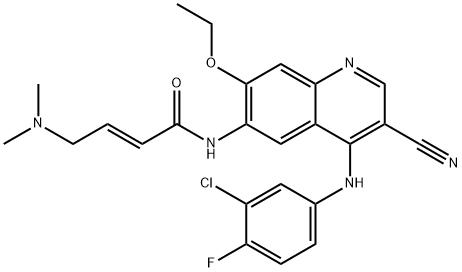
| Description | Pelitinib is a cyanoquinoline that irreversibly inhibits the EGFR receptor tyrosine kinase (IC50 = 39 nM). It inhibits HER2 with a much weaker potency (IC50 = 1.2 μM). By disrupting Akt and MAPK pathways, pelitinib can induce apoptosis and suppress the growth of tumor cell lines, displaying particularly strong efficacy against hepatocellular carcinoma cells (IC50s = ~2 μM). | | Chemical Properties | Off-White Solid | | Uses | Pelitinib is a 3-cyanoquinoline pan-ErbB tyrosine kinase inhibitor with potential antineoplastic activity. | | Uses | An EGFR inhibitor | | Uses | Labelled Pelitinib (P218702). A tyrosine kinase inhibitor; it is used to prepare formulation for treating primary or secondary cancer. | | references | [1] torrance cj, jackson pe, montgomery e, kinzler kw, vogelstein b, wissner a, nunes m, frost p, discafani cm. combinatorial chemoprevention of intestinal neoplasia. nat med. 2000 sep;6(9):1024-8.[2] nunes m, shi c, greenberger lm. phosphorylation of extracellular signal-regulated kinase 1 and 2, protein kinase b, and signal transducer and activator of transcription 3 are differently inhibited by an epidermal growth factor receptor inhibitor, ekb-569, in tumor cells and normal human keratinocytes. mol cancer ther. 2004 jan;3(1):21-7. |
| PELITINIB Preparation Products And Raw materials |
|


 日本语
日本语 한국어
한국어 Français
 Deutsch
 España
 Türkiye