Other grades of this product :
| Medroxyprogesterone Acetate Basic information |
| Medroxyprogesterone Acetate Chemical Properties |
| Melting point | 206-207 °C(lit.) | | alpha | D +61° (in chloroform) | | Boiling point | 432.7°C (rough estimate) | | density | 1.0346 (rough estimate) | | refractive index | 48 ° (C=1, Dioxane) | | storage temp. | Sealed in dry,2-8°C | | solubility | Practically insoluble in water, freely soluble in methylene chloride, soluble in acetone, sparingly soluble in ethanol (96 per cent) | | form | neat | | color | White | | Water Solubility | <0.1 g/100 mL at 23 ºC | | Merck | 13,5817 | | BRN | 2066112 | | Stability: | Stable, but weakly air and light sensitive. Incompatible with strong oxidizing agents. | | CAS DataBase Reference | 71-58-9(CAS DataBase Reference) | | IARC | 2B (Vol. 21, Sup 7) 1987 | | EPA Substance Registry System | Medroxyprogesterone acetate (71-58-9) |
| Hazard Codes | Xn | | Risk Statements | 40-48 | | Safety Statements | 22-36/37/39-45 | | WGK Germany | 3 | | RTECS | TU5010000 | | HS Code | 29372390 |
| Medroxyprogesterone Acetate Usage And Synthesis |
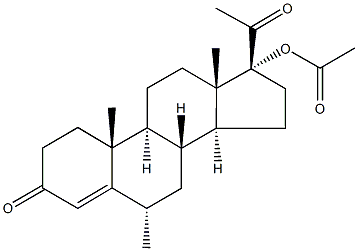
| Description | Medroxyprogesterone 17-acetate is a synthetic progestogen.,, It prevents fertilization and increases the rate of transport of eggs from the fallopian tubes to the uterus in female ferrets when administered prior to ovulation. Medroxyprogesterone 17-acetate reversibly blocks ovulation in rats when injected on the last day of diestrus. It also has anti-androgenic activity in rats, decreasing plasma testosterone (Item Nos. 15645 | ISO60154) levels via induction of hepatic testosterone reductase activity. Medroxyprogesterone 17-acetate exhibits immunosuppressive effects in vitro and in vivo, inhibiting the production of IFN-γ by CD2/CD3/CD28-stimulated peripheral blood mononuclear cells (PBMCs) at concentrations ≥10 nM and extending the survival of rabbit skin allografts., Injectable formulations containing medroxyprogesterone 17-acetate have been used as contraceptives. | | Chemical Properties | White or almost white, crystalline powder. | | Originator | Provera,Upjohn,US,1959 | | Uses | Progestogen; an injectable contraceptive. | | Uses | Medroxyprogesterone Acetate is a synthetic progesterone receptor agonist that is used to treat amenorrhea (unusual stopping of menstrual periods) and abnormal uterine bleeding. | | Definition | ChEBI: Medroxyprogesterone acetate is an acetate ester resulting from the formal condensation of the 17alpha-hydroxy group of medroxyprogesterone with the carboxy group of acetic acid. A widely used progestin in menopausal hormone therapy and in progestogen-only birth control. It has a role as a progestin, an androgen, a female contraceptive drug, a synthetic oral contraceptive, an adjuvant, an inhibitor, an antioxidant and an antineoplastic agent. It is a steroid ester, an acetate ester, a 20-oxo steroid, a 3-oxo-Delta(4) steroid and a corticosteroid. It is functionally related to a medroxyprogesterone. | | Brand name | Amen (Amarin);
Curretab (Solvay Pharmaceuticals); Cycrin (ESI); Provera
(Pharmacia & Upjohn);Clinovie;Cliovir;Dep0-clinover;Dep0-map;Depcorlutin;Depo-prodasone;Depo-progevera;Depo-promone;Deporone;Dugen;Farlurin;Farlutale;Gesinal;Gestapuran;Gestapuron;G-farlutal;Hysron;Intex;Luteocrin orale;Luteodione;Luteos;Lutoporal;Metigestene;Nadigest;Nogest;Onco-provera;Perlutest;Petogen;Piermap;Povera;Promone-e;Pronone;Proverone;Provest;Sindomens;Sodelut "g";Supprestal;Verafen;Veramix plus v. | | Therapeutic Function | Progestin | | World Health Organization (WHO) | A depot preparation containing 150 mg medroxyprogesterone
acetate was introduced over 20 years ago for use as a long-acting injectable
contraceptive. Subsequently, positive results of carcinogenicity studies carried out
in beagle bitches led to refusal of registration in the United States. These findings
were later considered irrelevant to contraceptive use in women and the drug was
approved by the Food and Drug Administration. Menstrual irregularities are the
most common adverse effect associated with depot medroxyprogesterone acetate.
Risk-benefit judgements differ significantly from country to country, having regard
to differing national circumstances. The preparation is, however, widely available
and is included in the WHO Model List of Essential Drugs.
(Reference: (WHTAC4) The Use of Essential Drugs, 4th Report of the WHO Expert
Committee, 796, , 1990) | | General Description | Medroxyprogesterone acetate is an odorless white to off-white microcrystalline powder. It?is a synthetic, acetate derivative of the sex hormone progesterone. (NTP, 1992) | | Air & Water Reactions | Medroxyprogesterone 17-acetate is sensitive to prolonged exposure to air and light. Insoluble in water. | | Reactivity Profile | Flammable and/or toxic gases are generated by the combination of alcohols with alkali metals, nitrides, and strong reducing agents. They react with oxoacids and carboxylic acids to form esters plus water. Oxidizing agents convert them to aldehydes or ketones. Alcohols exhibit both weak acid and weak base behavior. They may initiate the polymerization of isocyanates and epoxides. | | Hazard | Possible carcinogen. | | Fire Hazard | Flash point data for Medroxyprogesterone 17-acetate are not available; however, Medroxyprogesterone 17-acetate is probably combustible. | | Biochem/physiol Actions | Medroxyprogesterone 17-acetate (MPA) is a synthetic progestin used as a contraceptive, in hormone replacement therapy and for the treatment of endometriosis. It is a more potent progestin that the nonacetylated form. | | Clinical Use | Progestogen:
Cachexia (unlicensed), contraception, epilepsy, male
hypersexuality, malignant neoplasms, respiratory
disorders, sickle-cell disease, dysfunctional uterine
bleeding, endometriosis | | Safety Profile | Suspected carcinogen
with experimental carcinogenic, neoplastigenic, tumorigenic, and teratogenic data.
Human systemic effects by intravenous
route: increased intraocular pressure. Human teratogenic effects by an unspecified
route: developmental abnormalities of the
urogenital system. Human reproductive
effects by multiple routes:
spermatogenesis, menstrual cycle changes or
dlsorders, postpartum effects, female fertility
effects, abortion, newborn behavioral
effects. Human mutation data reported.
Experimental reproductive effects. A drug
for the treatment of secondary amenorrhoea
and dysfunctional uterine bleeding. When
heated to decomposition it emits acrid
smoke and irritating fumes. | | Veterinary Drugs and Treatments | In cats, MPA has been used when either castration is ineffective or
undesirable to treat sexually dimorphic behavior problems such as
roaming, inter-male aggressive behaviors, spraying, mounting, etc.
MPA has also been used as a tranquilizing agent to treat syndromes
such as feline psychogenic dermatitis and alopecia, but treatment
with “true” tranquilizing agents may be preferable.
In humans, parenteral MPA has been used as a long-acting
contraceptive in females, to decrease sexually deviant behavior in
males, and as an antineoplastic agent for some carcinomas (see
Pharmacology section above). Oral MPA is used in human females
to treat secondary amenorrhea and to treat abnormal uterine bleeding
secondary to hormone imbalances. | | Drug interactions | Potentially hazardous interactions with other drugs
Antibacterials: metabolism of progestogens
accelerated by griseofulvin and rifamycins (reduced
contraceptive effect).
Anticoagulants: progestogens antagonise
anticoagulant effect of phenindione and may enhance
or reduce effect of coumarins.
Antidepressants: contraceptive effect reduced by St
John’s Wort - avoid.
Antiepileptics: metabolism accelerated by
carbamazepine, eslicarbazepine, fosphenytoin,
lamotrigine, oxcarbazepine, perampanel,
phenytoin, phenobarbital, primidone, rufinamide
and topiramate (reduced contraceptive effect);
concentration of lamotrigine reduced.
Antivirals: contraceptive effect possibly reduced
by efavirenz; metabolism accelerated by nevirapine
(reduced contraceptive effect).
Aprepitant: possible contraceptive failure.
Bosentan: possible contraceptive failure.
Ciclosporin: progestogens inhibit metabolism of
ciclosporin (increased plasma concentration).
Cytotoxics: possibly reduced contraceptive effect
with crizotinib dabrafenib, olaparib and vemurafenib.
Dopaminergics: concentration of selegiline increased
- avoid.
Fosaprepitant: possible contraceptive failure.
Lumacaftor: possible contraceptive failure.
Ulipristal: contraceptive effect possibly reduced | | Metabolism | Among the first of these substituted 17α-acetoxyprogesterone analogues to be utilized therapeutically was medroxyprogesterone
acetate, a 6α-methyl progesterone analogue. This analogue is 25-fold more active than ethisterone. Following oral
administration, medroxyprogesterone acetate is completely and rapidly deacetylated by first-pass metabolism to
medroxyprogesterone. Medroxyprogesterone is extensively metabolized via pathways similar to those for progesterone, except for
6α-hydroxylation. Most medroxyprogesterone acetate metabolites are excreted in the urine, primarily as glucuronide conjugates.
Plasma protein binding for medroxyprogesterone is approximately 86%, primarily to serum albumin, with no binding to SHBG. |
| Medroxyprogesterone Acetate Preparation Products And Raw materials |
|


 日本语
日本语 한국어
한국어 Français
 Deutsch
 España
 Türkiye