Other grades of this product :
| 2,6-Di-tert-butyl-p-benzoquinone Basic information |
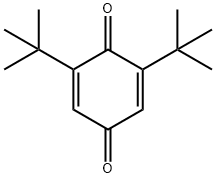
| Product Name: | 2,6-Di-tert-butyl-p-benzoquinone | | Synonyms: | 2,5-Cyclohexadiene-1,4-dione, 2,6-bis(1,1-dimethylethyl)-;3,5-Di-tert-butylquinone;3,5-Di-tert-butyl-1,4-benzoquinone;BHT-quinone;Benzoquinone, 2,6-di-(;2,6-Di-tert-butyl-p-benzoquinone, 98% 1GR;2,6-Di-tert-butylcyclohexa-2,5-diene-1,4-dione;2,6-bis(1,1-Dimethylethyl)-2,5-cyclohexadiene-1,4-dione | | CAS: | 719-22-2 | | MF: | C14H20O2 | | MW: | 220.31 | | EINECS: | 211-946-0 | | Product Categories: | C13 to C14;Carbonyl Compounds;Anthraquinones, Hydroquinones and Quinones;Benzoquinones;Ketones | | Mol File: | 719-22-2.mol |
| 2,6-Di-tert-butyl-p-benzoquinone Chemical Properties |
| 2,6-Di-tert-butyl-p-benzoquinone Usage And Synthesis |
| Chemical Properties | ORANGE TO BROWN CRYSTALS OR CRYSTALLINE POWDER | | Uses | 2.6-Di-tert-butyl-p-benzoquinone was used as a treatment agent to improve germination, plant health and yield. | | Uses | 2,6-Di-tert-butyl-1,4-benzoquinone was used as an antioxidant to study the elimination rate of micro pollutant from storm and waste water. It was also used as a metabolite of butylated hydroxytoluene. It is used as a treatment agent to improve germination and plant health. | | Synthesis Reference(s) | The Journal of Organic Chemistry, 30, p. 982, 1965 DOI: 10.1021/jo01015a006Tetrahedron Letters, 30, p. 5929, 1989 DOI: 10.1016/S0040-4039(01)93508-7 | | Purification Methods | It can be recrystallised from MeOH and sublimes in a vacuum. [Beilstein 7 IV 2116.] |
| 2,6-Di-tert-butyl-p-benzoquinone Preparation Products And Raw materials |
| Raw materials | DDQ-->2,6-DI-TERT-BUTYL-4-METHOXYPHENOL-->1,4-Benzenediol, 2,6-bis(1,1-dimethylethyl)-, 4-acetate-->2,4,6-Tri-tert-butylphenol-->3,3',5,5'-Tetra-tert-butyldiphenoquinone-->2,6-Di-tert-butylphenol | | Preparation Products | 3,3',5,5'-TETRA(TERT-BUTYL)[1,1'-BIPHENYL]-4,4'-DIOL-->2,6-di-tert-butylhydroquinone |
|


 日本语
 한국어
 Français
 Deutsch
 España
 Türkiye