| Chemical Properties | yellow crystals or powder |
| Uses | A non-specific PLA2 inhibitor. and acetylcholine receptor antagonist |
| Uses | Quinacrine is a derivative of acridine that is chemically and clinically very similar to
4-aminoquinolines. It was the primary drug for prevention and therapy of malaria during
World War II. Today it is rarely used for treating malaria, although it is used to treat amebiasis. Synonyms of this drug are mepacrine, atabrine, acrisuxin, and others.
In treating resistant forms of malaria, tetracycline is also used in combination with
pyrimethamine, sulfonamides, sulfones, and dapsone, which is widely used for treating
leprosy (as a rule, in combination with pyrimethamine). |
| Uses | Quinacrine dihydrochloride has been used:- in its uptake and accumulation studies in mouse lung slices using fluorescence microscope
- in the staining of ATP vesicles in mesenchymal stem cells (MSCs)
- in uptake-release assay for characterization of dense granule functionality of platelets
|
| Indications | Quinacrine is no longer used extensively as an antimalarial
drug and has been largely replaced by the 4-
aminoquinolines. |
| Brand name | Dormison (Schering). |
| Antimicrobial activity | Mepacrine is active against the asexual erythrocytic stage of
all four Plasmodium spp. that infect humans and the gametocytes
of P. vivax and P. malariae. The enantiomers have equal
antimalarial activity. It exhibits broad activity
in experimental
models against T. cruzi, Leishmania spp., E. histolytica,
Trichomonas vaginalis, G. lamblia and Blastocystis hominis. It is
also active against tapeworms. |
| Acquired resistance | The structural resemblance to chloroquine suggests the likelihood
of cross-resistance with that drug, but evidence for this
is equivocal. |
| General Description | Bright yellowish needles or bright yellow powder. Odorless. pH of a 1% aqueous solution is about 4.5.. Used as an anti-malarial drug. Moderately toxic. |
| Air & Water Reactions | Water soluble. |
| Reactivity Profile | QUINACRINE DIHYDROCHLORIDE is an acidic salt of an amine. React as a weak acid to neutralize bases. |
| Fire Hazard | Flash point data for QUINACRINE DIHYDROCHLORIDE are not available, but QUINACRINE DIHYDROCHLORIDE is probably combustible. |
| Pharmaceutical Applications | A synthetic acridine derivative, formulated as the hydrochloride
for oral use. |
| Biochem/physiol Actions | Target IC50: 4.4 μM in suppressing glibenclamide-sensitive K+-currents |
| Pharmacokinetics | Oral absorption: Good
Cmax 100 mg oral: 50 μg/L after 1–3 h
Plasma half-life: 5 days
Plasma protein binding: 85%
There is extensive tissue binding and a six-fold concentration into
leukocytes from plasma. About 10% of the daily dose is excreted
in the urine. It is widely distributed throughout the body. |
| Clinical Use | Giardiasis
Prophylaxis of malaria
Tapeworm infections |
| Side effects | Dizziness, headache and gastric problems are common.
Toxic psychoses, bone marrow depression, yellow skin and
exfoliative dermatitis are described. Poor toleration is noted,
especially
in children. It should not be used in combination
with 8-aminoquinolines. |
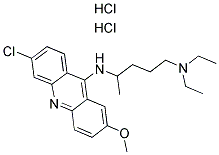
| Synthesis | Quinacrine, 6-chloro-9-(4-diethylamino-1-methylbutylamino)-2-methoxyacridine (37.1.4.3), is synthesized from 6,9-dichloro-2-methoxyacridine (37.1.4.2) and
aforementioned 4-diethylamino-1-methylbutylamine (37.1.1.2). The 6,9-dichloro-
2-methoxyacridine (37.1.4.2) necessary for the synthesis is made in two stages. The initial
reaction of 2,4-dichlorobenzoic acid and p-anizidine in the presence of copper dust and
potassium carbonate gives 2-(4-methoxyanilino)-4-chlorobenzoic acid (37.1.4.1), which
upon reaction with phosphorus oxychloride turns into the necessary 6,9-dichloro-
2-methoxyacridine (37.1.4.2). |
| Purification Methods | It crystallises from H2O (solubility is 2.8% at room temperature) as yellow crystals. It is slightly soluble in MeOH and EtOH. The free base crystallises from Me2CO or pet ether with m 86-88o, or aqueous EtOH with 85-87.5o. The bismethiodide has m 224o (from MeOH/EtOAc/Et3N), and the picrate has m 207-208o(dec) when crystallised from Me2CO/EtOH. It is an antimalarial, antiprotozoal and intercalates DNA. [Wolfe Antibiot 3 (Springer-Verlag) 203 1975, Beilstein 22 III/IV 6247, 22/12 V 235.] |


 日本语
日本语 한국어
한국어 Français
 Deutsch
 España
 Türkiye