Other grades of this product :
| 2,3-Lutidine Basic information |
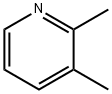
| Product Name: | 2,3-Lutidine | | Synonyms: | 2,3-DIMETHYLPYRIDINE(2,3-LUTIDINE);a,b-Dimethylpyridine;2,3-Lutidine (8CI);Pyridine, 2,3-dimethyl- (9CI);2,3-Lutidine, 98+% 100ML;2,3- twoMethylpyridine;2,3-Lutidine 99%;LUT | | CAS: | 583-61-9 | | MF: | C7H9N | | MW: | 107.15 | | EINECS: | 209-514-1 | | Product Categories: | Biochemistry;Reagents for Oligosaccharide Synthesis;Pyridines derivates;Heterocyclic Compounds;bc0001 | | Mol File: | 583-61-9.mol |
| 2,3-Lutidine Chemical Properties |
| Melting point | -15 °C (lit.) | | Boiling point | 162-163 °C (lit.) | | density | 0.945 g/mL at 25 °C (lit.) | | refractive index | n20/D 1.508(lit.) | | Fp | 122 °F | | storage temp. | Inert atmosphere,Room Temperature | | pka | 6.57(at 25℃) | | form | Liquid | | color | Clear colorless to slightly yellow | | Water Solubility | 95 g/L (26 ºC) | | BRN | 106418 | | InChIKey | HPYNZHMRTTWQTB-UHFFFAOYSA-N | | CAS DataBase Reference | 583-61-9(CAS DataBase Reference) | | NIST Chemistry Reference | Pyridine, 2,3-dimethyl-(583-61-9) | | EPA Substance Registry System | 2,3-Dimethylpyridine (583-61-9) |
| 2,3-Lutidine Usage And Synthesis |
| Chemical Properties | clear colorless to slightly yellow liquid | | Uses | 2,3-Lutidine is a lansoprazole intermediates. It is used as pharmaceutical intermediate. | | Synthesis Reference(s) | The Journal of Organic Chemistry, 66, p. 53, 2001 DOI: 10.1021/jo000724t | | Purification Methods | Steam distil it from a solution containing about 1.2 equivalents of 20% H2SO4, until ca 10% of the base has been carried over with the non-basic impurities. The acidic solution is then made alkaline, and the base is separated, dried over NaOH or BaO, and fractionally distilled. The distilled lutidine is converted to its urea complex by stirring 100g with 40g of urea in 75mL of H2O, cooling to 5o, filtering at the pump, and washing with 75mL of H2O. The complex, dissolved in 300mL of H2O, is steam distilled until the distillate gives no turbidity with a little solid NaOH. The distillate is then treated with excess solid NaOH, and the upper layer is removed: the aqueous layer is then extracted with diethyl ether. The upper layer and the ether extract are combined, dried (K2CO3), and distilled through a short column. Final purification is by fractional crystallisation using partial freezing. The picrate crystallises from EtOH with m 187-188o. [Kyte et al. J Chem Soc 4454 1960, Beilstein 20 H 243, 20 II 159, 20 III/IV 2765, 20/6 V 15.] |
| 2,3-Lutidine Preparation Products And Raw materials |
| Raw materials | 2,3,4-trimethylpyridine-->Pyridine, 1,2,3,4-tetrahydro-5,6-dimethyl--->(2-Methylpyridin-3-yl)methyl acetate-->Ethanone, 1-(1-methyl-3-piperidinyl)- (9CI)-->2,3,6-TRIMETHYLPYRIDINE-->(2-METHYL-PYRIDIN-3-YL)-METHANOL-->3-Ethylpyridine-->Ethyl 2-methylnicotinate | | Preparation Products | 2-Chloromethyl-3-methyl-4-(2,2,2-trifluoroethoxy)pyridine hydrochloride-->3-METHYL-2-PYRIDINECARBOXALDEHYDE-->2-HYDROXYMETHYL-3-METHYLPYRIDINE-->2,3-DIMETHYL-PYRIDIN-4-YLAMINE-->2-Chloromethyl-3-methyl-4-(3-methoxypropoxy)pyridine hydrochloride-->4-Chloro-2,3-dimethylpyridine 1-oxide-->Lansoprazole-->2-HYDROXYMETHYL-4-METHOXYPROPOXY-3-METHYLPYRIDINE-->4-Nitro-2,3-lutidine-N-oxide-->2,3-Dimethylpyridine-N-oxide-->2,6-Lutidine-->Pyridine |
|


 日本语
日本语 한국어
한국어 Français
 Deutsch
 España
 Türkiye