Other grades of this product :
| Famoxadone Basic information |
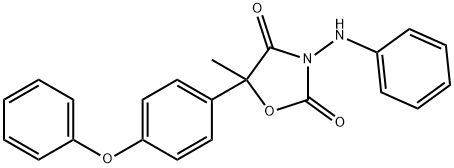
| Product Name: | Famoxadone | | Synonyms: | 3-anilino-5-methyl-5-(4-phenoxyphenyl)-1,3-oxazolidine-2,4-dione;5-methyl-5-(4-phenoxyphenyl)-3-(phenylamino)-2,4-oxazolidinedione;Famoxate;Semicarbacide Hydrochloride, Vetranal;5-Methyl-5-(4-phenoxyphenyl)-3-(phenylamino)oxazolidine-2,4-dione;famoxadone (bsi, pa iso);famoxadone solution;Famoxadon | | CAS: | 131807-57-3 | | MF: | C22H18N2O4 | | MW: | 374.39 | | EINECS: | 603-520-1 | | Product Categories: | API;agrochemical;Fungicide | | Mol File: | 131807-57-3.mol |
| Famoxadone Chemical Properties |
| Melting point | 140.3~141.8℃ | | Boiling point | 491.3±55.0 °C(Predicted) | | density | 1.327±0.06 g/cm3(Predicted) | | vapor pressure | 6.4 x 10⁻⁷ Pa (20 °C) | | Fp | 2 °C | | storage temp. | 0-6°C | | Water Solubility | 0.243 mg-1 (pH 5), 0.011 mg l-1 (pH 7)
at 20 °C | | pka | 0.63±0.40(Predicted) | | form | Solid:particulate/powder | | LogP | 4.65-5.08 at 20℃ and pH4-7 | | Surface tension | 73mN/m at 90μg/L and 20.4℃ | | EPA Substance Registry System | Famoxadone (131807-57-3) |
| Famoxadone Usage And Synthesis |
| Description | Famoxadone is an oxazolidinedione
fungicide. Although famoxadone is not a strobilurin
derivative, it shares the same mechanism of action. Famoxadone provides control of a broad spectrum of
fungi but is particularly effective against downy mildew
(P. viticola), late and early blights (Phytophthora infestans
and Alternaria solani), the Septoria complex, and barley
net blotch at rates of 50 to 200 g ai/ha. Target crops include
vines, potatoes/tomatoes, cereals, sugar beets, canola, and
cucumber. It shows good protectant, translaminar and residual control, with excellent rainfastness and good crop
safety. As was seen for trifloxystrobin, it is particularly
effective against grape downy mildew when applied in
mixture with cymoxanil. The cereal disease spectrum and
level of disease control are improved when famoxadone is
mixed with triazole fungicides such as flusilazole. | | Chemical Properties | Brown Solid | | Uses | Famoxadone is a known fungicide used in the protection of agricultural products against various fungal diseases and other biotic stresses such as pests. | | Uses | Agricultural fungicide. | | Uses | Famoxadone provides preventive control of a broad spectrum of
fungal pathogens such as Plasmopara viticola (grape downy mildew), Phytophthora
infestans (potato/ tomato late blight), Pseudoperonospora cubensis
(cucumber downy mildew), Septoria tritici (wheat leaf blotch), S. nodorum
(wheat glume blotch) and Alternaria solani (potato/tomato early blight). | | Agricultural Uses | Fungicide: Tanos 50-DF is recommended for use as a preventative
fungicide for control of late blight and early blight on
potatoes and field tomatoes. | | Trade name | DPX-JE874®; FAMOXATE®; MEDLEY®;
TANOS-50DF® | | Pharmacology | Famoxadone inhibits activity of ubiquinol : cytochrome
c oxidoreductase at the Qo site of complex III,
the same target protein as the strobilurins (34,35). However,
studies show a difference in the potency of various
strobilurins compared with famoxadone in single amino
acid mutants of the cytochrome b protein, suggesting that
this compound may interact differently with the target
protein (38). | | Metabolic pathway | Famoxadone undergoes extensive degradation and metabolism in aqueous
and soil environments, in wheat plants, rats, goats and hens via common
pathways. The primary reactions include the hydrolytic opening of
the oxazolidinedione ring, aryl hydroxylation, cleavage of the phenoxyphenyl
and the oxazolidinedione-aminophenyl linkages and conjugation.
More than 25 degradation products have been identified. | | Degradation | Famoxadone is relatively stable to hydrolytic degradation under dark
conditions in pH 5 buffer solution (DT50 41 days) (Jernberg et al., 1998a). It
was hydrolysed rapidly at pH 7 and pH 9 at 25 °C (DT50 values 2 days and
<2 hours, respectively). No sigruficant sunlight-induced degradation was
observed at pH 7. Hydrolytic degradation was catalysed in acidic conditions
(pH 5) under natural sunlight (DT50 4.6 days in contrast to 41 days at
pH 7). Primary hydrolytic degradation reactions include the opening
of the oxazolidinedione ring [to yieldα-hydroxy-α-methyl-4-phenoxyphenylacetic acid 2-phenylhydrazide (2) and 1-carboxy-1-(4-phenoxy-phenyl) ethyl-2-phenylhydrazinecarboxylic acid (3)], and the cleavage
of the oxazolidine-aminophenyl linkage to yield various products from
both the phenoxyphenyl moiety [ 1-(4-phenoxyphenyl)ethanone (4) and α-hydroxy-
α-methyl-4-phenoxyphenylacetiac acid (5)] and the aminophenyl moiety [small amounts of phenol (6), catechol (7) and benzene (8) via
the proposed 2-phenylhydrazinecarboxylic acid intermediate (9)] (see
Scheme 1). | | Toxicity evaluation | Famoxadone has an acute oral LD50 > 5,000 mg/kg and
an acute percutaneous LD50 > 2,000 mg/kg in rats. It is
not a skin or eye irritant, is negative in the Ames test, and
is nonteratogenic. It shows very little soil degradation, is
nonmobile, and has a good ecotoxicological profile. |
| Famoxadone Preparation Products And Raw materials |
|


 日本语
日本语 한국어
한국어 Français
 Deutsch
 España
 Türkiye