Other grades of this product :
| D-α-Tocopherol succinate Basic information |
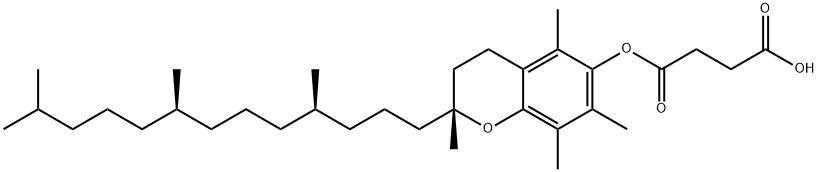
| Product Name: | D-α-Tocopherol succinate | | Synonyms: | 1210IU D-α-Tocopherol succinate,vitamin E succinate 1185IU D-α-Tocopherol succinate,vitamin E succinate;(+)-α-TOCOPHEROL ACID SUCCINATE;D-α-Tocopheryl succinate, Ph. Eur.;[2theta-[2theta(4theta,8theta)]]-cyl)-2h-1-benzopyran-6-yl]este;alpha-tocopherol,succinate;alpha-tocopherolhemisuccinate;butanedioicacid,mono(3,4-dihydro-2,5,7,8-tetramethyl-2-(4,8,12-trimethyltride;butanedioicacid,mono[3,4-dihydro-2,5,7,8-tetramethyl-2-(4,8,12-trimethyltride | | CAS: | 4345-03-3 | | MF: | C33H54O5 | | MW: | 530.78 | | EINECS: | 224-403-8 | | Product Categories: | Vitamins and derivatives;Vitamin Ingredients;Aromatics;Chiral Reagents;Heterocycles;1185IU/1210IU;Intermediates & Fine Chemicals;Pharmaceuticals | | Mol File: | 4345-03-3.mol |
| D-α-Tocopherol succinate Chemical Properties |
| Melting point | ~76 °C(lit.) | | Boiling point | 625.8±55.0 °C(Predicted) | | density | 1.002±0.06 g/cm3(Predicted) | | vapor pressure | 0Pa at 20℃ | | storage temp. | -20°C | | solubility | Practically insoluble in water, very soluble in methylene chloride, soluble in acetone and in anhydrous ethanol. | | form | neat | | pka | 4.35±0.17(Predicted) | | color | White or off-white | | λmax | 286nm(EtOH)(lit.) | | Merck | 14,9495 | | BRN | 4038233 | | Stability: | Stable for 2 years from date of purchase as supplied. Solutions in DMSO or ethanol may be stored at -20° for up to 1 month. | | LogP | 12 at 25℃ | | CAS DataBase Reference | 4345-03-3(CAS DataBase Reference) | | EPA Substance Registry System | D-.alpha.-Tocopheryl acid succinate (4345-03-3) |
| WGK Germany | 1 | | RTECS | EJ9984000 | | F | 8-10-23 | | HS Code | 2936280000 | | Toxicity | LD50 oral in rat: > 7gm/kg |
| D-α-Tocopherol succinate Usage And Synthesis |
| Description | Tocopherol succinate (4345-03-3) is a potent antioxidant. Protects mice from gamma-radiation by induction of granulocyte-colony stimulating factor.1,2?Tocopherol succinate induces apoptosis in human gastric cancer cells3?and inhibits proliferation of mesothelioma cells by down-regulation of fibroblast growth factor receptor-14. Induces apoptosis in neuroblastoma cells.5 | | Chemical Properties | Off-White to Pale Yellow Solid | | Uses | A potent antioxidant tocopherol | | Uses | A potent novel antineoplastic agent with high selectivity and cooperativity with tumor necrosis factor-related apoptosis-inducing ligand (Apo2 ligand). It inhibits proliferation of mesothelioma cells by selective down-regulation of fibroblast growth factor receptors. Furthermore, it has been shown to enhance the anti-tumor effect of dendritic cell vaccines. | | Uses | A potent novel antineoplastic agent with high selectivity and cooperativity with tumor necrosis factor-related apoptosis-inducing ligand (Apo2 ligand). It inhibits proliferation of mesothelioma cells
by selective down-regulation of fibroblast growth factor receptors. Furthermore, it has been shown to enhance the anti-tumor effect of dendritic cell vaccines. | | General Description | White powder. | | Air & Water Reactions | Insoluble in water. | | Reactivity Profile | Vitamin E succinate is an ester. Esters react with acids to liberate heat along with alcohols and acids. Strong oxidizing acids may cause a vigorous reaction that is sufficiently exothermic to ignite the reaction products. Heat is also generated by the interaction of esters with caustic solutions. Flammable hydrogen is generated by mixing esters with alkali metals and hydrides. | | Fire Hazard | Flash point data for Vitamin E succinate are not available; however, Vitamin E succinate is probably combustible. | | Flammability and Explosibility | Notclassified | | Biochem/physiol Actions | Tocopherol exhibits antioxidant property by protecting the cells and membranes from oxidative stress. In plants, high levels of α-tocopherol leads to plant stress tolerance whereas low levels is associated with oxidative stress. In humans, tocopherol prevents cancer, premature aging, atherosclerosis, arthritis caused due to free radicals. Vitamin E succinate (VES) is an anti-tumor analog of vitamin E. | | Safety Profile | When heated to
decomposition it emits acrid smoke and
irritating fumes. | | References | 1) Singh?et al. (2010),?Alpha-tocopherol succinate protects mice from gamma-radiation by induction of granulocyte-colony stimulating factor; Int. J. Radiation Biol.,?86?12
2) Singh?et al. (2009),?Tocopherol succinate: a promising radiation countermeasure; Immunopharmacol.,?9?1423
3) Wu?et al. (2004),?c-Jun N-terminal kinase is required for vitamin E succinate-induced apoptosis in human gastric cancer cells; J. Gastroenterol.,?10?1110
4) Stapelberg?et al. (2004),?alpha-Tocopheryl succinate inhibits proliferation of mesothelioma cells by selective down-regulation of fibroblast growth factor receptors; Biochem. Biophys. Res. Commun.,?318?636
5) Swettenham?et al. (2005),?Alpha-tocopheryl succinate selectively induces apoptosis in neuroblastoma cells: potential therapy of malignancies of the nervous system; J. Neurochem.,?94?1448 |
| D-α-Tocopherol succinate Preparation Products And Raw materials |
|


 日本语
日本语 한국어
한국어 Français
 Deutsch
 España
 Türkiye