Other grades of this product :
| 6-Biopterin Basic information |
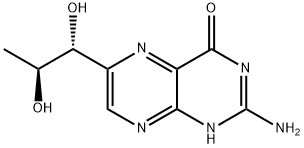
| Product Name: | 6-Biopterin | | Synonyms: | [S-(R*,S*)]-2-amino-6-(1,2-dihydroxypropyl)-1H-pteridin-4-one;L-Biopterin,2-Amino-4-hydroxy-6-(1,2-dihydroxypropyl)pteridine;L-Biopterin(6-Biopterin);2-amino-6-(1,2-dihydroxypropyl)-1H-pteridin-4-one;(1R,2S)-Biopterin, 2-Amino-4-hydroxy-6-(1,2-dihydroxypropyl)pteridine, L-erythro-6-(1,2-Dihydroxypropyl)pterin;2-Amino-6-[(1S,2R)-1,2-dihydroxypropyl]pteridin-4(1H)-one;2-Amino-6-[(1S,2R)-1,2-dihydroxypropyl]pteridine-4(3H)-one;D-erythro-Biopterin | | CAS: | 22150-76-1 | | MF: | C9H11N5O3 | | MW: | 237.22 | | EINECS: | 244-807-8 | | Product Categories: | Fluorescent Labels & Indicators;Bases & Related Reagents;Chiral Reagents;Heterocycles;Nucleotides | | Mol File: | 22150-76-1.mol |
| 6-Biopterin Chemical Properties |
| Melting point | >210°C dec. | | alpha | D24 -50° (c = 0.4 in 0.1N HCl); D24 -26° (c = 0.92 in 0.1N NaOH) | | Boiling point | 379.74°C (rough estimate) | | density | 1.3472 (rough estimate) | | refractive index | 1.7610 (estimate) | | storage temp. | 2-8°C | | solubility | Aqueous Acid (Slightly, Heated, Sonicated) | | form | White to pale yellow powder. | | pka | 13.18±0.20(Predicted) | | color | White to Light Yellow | | Merck | 13,1229 | | BRN | 87860 | | Stability: | Hygroscopic | | CAS DataBase Reference | 22150-76-1(CAS DataBase Reference) |
| Hazard Codes | Xi | | Risk Statements | 36/37/38 | | Safety Statements | 26-36 | | WGK Germany | 3 | | RTECS | UO3506000 | | F | 10-23 | | HS Code | 29339900 | | Toxicity | sln-par-dmg 10 mg/L MUREAV 128,147,84 |
| 6-Biopterin Usage And Synthesis |
| Description | 6-Biopterin (L-Biopterin) is the oxidized form of tetrahydro-L-biopterin (BH4), a nitric oxide synthase (NOS) cofactor. L-Biopterin can be reduced to BH4 via thioredoxin reductase followed by dihydropteridine reductase or reduced glutathione. It is extremely toxic to human melanocytes in culture (IC50 = 0.2 μM after 48 hrs). L-Biopterin is rarely found under physiological conditions except in the epidermis of patients with the depigmentation disorder Vitiligo. | | Chemical Properties | Crystalline Solid | | Uses | L-Biopterin is a pteridine widely distributed in nature; naturally occurring as the L-erythro-form. Considered as a growth factor for some insects. Fluoresces with a blue color in alkaline solution. | | Definition | 6-Biopterin is an enzymatic cofactor derived from pterin and involved in certain oxidation-reduction reactions. It is a biopterin in which the 1,2-dihydroxypropyl group has (1R,2S)-configuration; naturally occurring form. It is an enantiomer of a D-erythro-biopterin. | | Application | 6-Biopterin is an oxidation product from the melanogenesis regulating cofactor (6R)5,6,7,8 tetrahydrobiopterin (6-BH4). In vitro, 6-Biopterin is cytotoxic to melanocytes. However, in vivo, 6-Biopterin is rapidly and sequentially reduced back to 6-GH4 via q-BH2. Recent studies suggest that 6-Biopterin among other pteridines may be a useful non-invasive biomarker for cancer. | | Preparation | Biopterin is synthesized by reacting 2,4,5-triamino-6-hydroxypyrimidine with 5-deoxy-L-arabinosone in aqueous solution at pH of about 7.5 to 10, acidifying and then recrystallizing by dissolving in basic solution and precipitating with acid. 5-deoxy-L-arabinosone is prepared by oxidizing S-deoxy-L-arabinose, which is prepared from L-rhamnose, using cupric acetate.Process for the synthesis of biopterin | | Safety Profile | Moderately toxic by ingestion andintraperitoneal routes. Mutation data reported. Whenheated to decomposition it emits toxic vapors of NOx. |
| 6-Biopterin Preparation Products And Raw materials |
|


 日本语
日本语 한국어
한국어 Français
 Deutsch
 España
 Türkiye