Other grades of this product :
| Meptazinol Basic information |
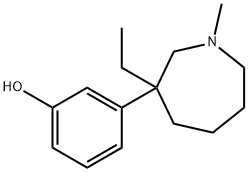
| Product Name: | Meptazinol | | Synonyms: | MEPTAZINOL;3-(3-ethylhexahydro-1-methyl-1h-azepin-3-yl)-phenol;3-(1-Methyl-3-ethylhexahydro-1H-azepine-3-yl)phenol;(+/-)-3-(3-ethyl-1-Methylhexahydro-1H-azepin-3-yl)phenol;Meptazinol A;3-(3-ethyl-1-Methylazepan-3-yl)phenol;MeptaMizol;Meptazinol-13C-d3 | | CAS: | 54340-58-8 | | MF: | C15H23NO | | MW: | 233.35 | | EINECS: | 259-109-9 | | Product Categories: | | Mol File: | 54340-58-8.mol |
| Meptazinol Chemical Properties |
| Melting point | 127-133°C | | Boiling point | 354.8±35.0 °C(Predicted) | | density | 0.997 | | pka | 9.95±0.10(Predicted) |
| Meptazinol Usage And Synthesis |
| Originator | Meptid,Wyeth,UK,1983 | | Uses | Analgesic. | | Manufacturing Process | 2-(m-Methoxyphenyl)butyronitrile in dry ether was added to a stirred suspension of sodium amide in liquid ammonia. The mixture was stirred for 30 minutes then ethyl-4-iodobutyrate (99.25 g, 0.4 mol) in dry ether (200 ml) was added dropwise. The mixture was stirred at the temperature of refluxing liquid ammonia for 5 hours. Ammonium chloride (10 g) was added and the mixture allowed to warm to room temperature. Water (300 ml) was added, the organic layer separated, washed with water, 2 N sulfuric acid and water. After drying over magnesium sulfate and removing the ether, the product was distilled yielding ethyl 5-cyano-5-(mmethoxyphenyl)heptanoate. That material was hydrogenated in cyclohexane using a Raney nickel catalyst. The product after distillation was recrystallized from ethyl acetate affording 10.0 g of 6-ethyl-(m-methoxyphenyl)hexahydro-2H-azepin-2one, MP 87°C to 88°C. The azepinone (9.1 g) in dry tetrahydrofuran (50 ml) and ether (50 ml) was added dropwise to a stirred suspension of aluminum lithium hydride (7.5 g) in dry ether (50 ml). After heating under reflux for 3 hours the reaction mixture was worked up and distilled yielding 7.66 g of a compound which was a colorless oil, BP 108°C to 110°C/0.01 mm.
That product was then heated under reflux with 50% hydrobromic acid for 1.5
hours. The reaction mixture was evaporated to dryness and reevaporated with
three portions of propan-2-ol. The oil obtained was dissolved in propan-2-ol
and diluted with ether. 3-Ethyl-3-(m-hydroxyphenyl)hexahydro-1H-azepine
was obtained. That material in turn was reductively methylated by
hydrogenation in the presence of formaldehyde in absolute ethanol solution to
give 3-ethyl-3-(m-methoxyphenyl)-1-methylhexahydro-1H-azepine.
The methoxy group was converted to a hydroxy group by refluxing with 80%
HBr giving meptazinol hydrobromide. | | Therapeutic Function | Analgesic | | Clinical Use | Opioid analgesic used for moderate to severe pain | | Drug interactions | Potentially hazardous interactions with other drugsAntidepressants: possible CNS excitation or
depression with MAOIs - avoid; possible CNS
excitation or depression with moclobemide; possibly
increased sedative effects with tricyclics.
Antihistamines: increased sedative effects with
sedating antihistamines.
Antipsychotics: enhanced hypotensive and sedative
effects.
Dopaminergics: avoid with selegiline.
Nalmefene: avoid concomitant use.
Sodium oxybate: enhanced effect of sodium oxybate
- avoid | | Metabolism | Meptazinol is extensively metabolised in the liver and is
excreted mainly in the urine as the glucuronide conjugate.
Less than 10% of a dose has been recovered from the
faeces. |
| Meptazinol Preparation Products And Raw materials |
|


 日本语
日本语 한국어
한국어 Français
 Deutsch
 España
 Türkiye