Other grades of this product :
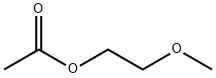
| 2-Methoxyethyl acetate Basic information |
| 2-Methoxyethyl acetate Chemical Properties |
| Melting point | −65 °C(lit.) | | Boiling point | 145 °C(lit.) | | density | 1.009 g/mL at 25 °C(lit.) | | vapor pressure | 4.7 hPa (20 °C) | | refractive index | n20/D 1.402(lit.) | | Fp | 111 °F | | storage temp. | Store below +30°C. | | solubility | Soluble in alcohol and ether (Weast, 1986). | | form | Solid | | color | White | | explosive limit | 1.7-8.8%(V) | | Water Solubility | Miscible (Lyman et al., 1982) | | λmax | λ: 254 nm Amax: 1.00λ: 275 nm Amax: 0.15λ: 300 nm Amax: 0.05λ: 350-400 nm Amax: 0.01 | | Merck | 14,6039 | | BRN | 1700761 | | Henry's Law Constant | (x 10-6 atm?m3/mol):
3.28 at 30.00 °C (headspace-GC, Hovorka et al., 2002) | | Exposure limits | NIOSH REL: TWA 0.1 ppm (0.5 mg/m3), IDLH 200 ppm; OSHA PEL: TWA
25 ppm (120 mg/m3); ACGIH TLV: TWA 5 ppm (24 mg/m3). | | CAS DataBase Reference | 110-49-6(CAS DataBase Reference) | | EPA Substance Registry System | Ethylene glycol monomethyl ether acetate (110-49-6) |
| Hazard Codes | T | | Risk Statements | 60-61-20/21/22 | | Safety Statements | 53-45 | | RIDADR | UN 1189 3/PG 3 | | WGK Germany | 1 | | RTECS | KL5950000 | | Autoignition Temperature | 380 °C DIN 51794 | | HS Code | 2915 39 00 | | HazardClass | 3 | | PackingGroup | III | | Hazardous Substances Data | 110-49-6(Hazardous Substances Data) | | Toxicity | LD50 orally in rats: 3.4 g/kg (Smyth) | | IDLA | 200 ppm |
| 2-Methoxyethyl acetate Usage And Synthesis |
| Chemical Properties | CLEAR LIQUID | | Chemical Properties | Methoxyethyl acetate is a colorless liquid.
Mild, ethereal odor. | | Physical properties | Colorless liquid with a mild, ether-like odor. Experimentally determined detection and recognition
odor threshold concentrations were 1.6 mg/m3 (330 ppbv) and 3.1 mg/m3 (640 ppbv), respectively
(Hellman and Small, 1974). | | Uses | Lacquer industry; textile printing;
manufacture of photographic film, coatings,
and adhesives | | Uses | Industrial solvent. | | General Description | A clear colorless liquid with a pleasant odor. Flash point of 135°F. Denser than water and soluble in water. Vapors are heavier than air. | | Air & Water Reactions | Flammable. Water soluble. Reacts slowly in water to form acetic acid and methyl alcohol; the reaction is not violent. | | Reactivity Profile | Esters react with acids to liberate heat along with alcohols and acids. Strong oxidizing acids may cause a vigorous reaction that is sufficiently exothermic to ignite the reaction products. Heat is also generated by the interaction of esters with caustic solutions. Flammable hydrogen is generated by mixing esters with alkali metals and hydrides. | | Hazard | Toxic by ingestion, inhalation, and skin
absorption. Moderate fire risk. Toxic by skin
absorption. | | Health Hazard | May cause irritation if splashed into eyes. Can be absorbed through the skin. Swallowing a large single dose or absorbing larged amount through skin could result in death. It is unlikely that air levels of the compound would be dangerous unless it is heated. | | Fire Hazard | Special Hazards of Combustion Products: Irritating vapors and toxic gases, such as carbon monoxide, may be formed when involved in fire. | | Safety Profile | Moderately toxic by
ingestion, intraperitoneal, and subcutaneous
routes. hfddly toxic by inhalation and skin
contact. Human systemic effects by
inhalation: eye lachrymation, cough, and
pulmonary changes. Experimental
reproductive effects. Mutation data
reported. An inhalation irritant in humans.
An eye irritant. Flammable liquid when
exposed to heat or flame; can react with
oxidizing materials. A moderate explosion
hazard. To fight fire, use CO2, dry chemical.
When heated to decomposition it emits
acrid smoke and irritating fumes. See also
GLYCOL ETHERS. | | Potential Exposure | Methoxyethyl acetate is used as
a solvent for resins, oils, greases and inks. It is also an
ingredient of lacquers, paints and adhesives. | | Environmental fate | Chemical/Physical. Hydrolyzes in water forming methyl cellosolve and acetic acid.
At an influent concentration of 1,024 mg/L, treatment with GAC resulted in an effluent
concentration of 886 mg/L. The adsorbability of the carbon used was 28 mg/g carbon (Guisti et
al., 1974). | | Shipping | UN1189 Ethylene glycol monomethyl ether
acetate, Hazard Class: 3; Labels: 3-Flammable liquid. | | Purification Methods | Shake the methoxy-ethane with anhydrous Na2CO3, filter and distil it in a vacuum. Redistillation can be then be carried out at atmospheric pressure. [Dunbar & Bolstad J Org Chem 21 1041 1956, Beilstein 2 IV 214.] | | Waste Disposal | Dissolve or mix the material
with a combustible solvent and burn in a chemical incinerator equipped with an afterburner and scrubber. All federal,
state, and local environmental regulations must be
observed. Beware of possible presence of peroxides in
which case open burning may be used |
| 2-Methoxyethyl acetate Preparation Products And Raw materials |
|


 日本语
日本语 한국어
한국어 Français
 Deutsch
 España
 Türkiye