Other grades of this product :
| Cystamine dihydrochloride Basic information |
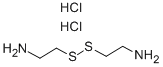
| Product Name: | Cystamine dihydrochloride | | Synonyms: | 2,2’-dithiobis-ethanamindihydrochloride;2,2’-dithiobis-ethylamindihydrochloride;2-aminoethyldisulfidedihydrochloride;aed;Cystamine dihydrochloride, 98+%;bis-B-aminoethyldisulphide dihydrochloride;2,2μ-Diaminodiethyl disulfide dihydrochloride, 2,2μ-Dithiobis(ethylamine) dihydrochloride, Decarboxycystine dihydrochloride;Ethylamine, 2,2'-dithiobis-, dihydrochloride | | CAS: | 56-17-7 | | MF: | C4H14Cl2N2S2 | | MW: | 225.2 | | EINECS: | 200-260-7 | | Product Categories: | Pyridines;Building Blocks;Chemical Synthesis;Organic Building Blocks;Sulfides/Disulfides;Sulfur Compounds;Pharmaceutical Intermediates;56-17-7 | | Mol File: | 56-17-7.mol |
| Cystamine dihydrochloride Chemical Properties |
| Melting point | 217-220 °C (dec.)(lit.) | | storage temp. | Store below +30°C. | | solubility | H2O: soluble1.0g/10 mL, clear to almost clear, colorless to almost colorless (<5.5 NTU) | | form | Crystalline Powder, Crystals or Chunks | | color | White to yellow | | Water Solubility | soluble | | Sensitive | Hygroscopic | | Merck | 14,2776 | | BRN | 3616850 | | Stability: | Stable. Incompatible with strong oxidizing agents. | | CAS DataBase Reference | 56-17-7(CAS DataBase Reference) | | EPA Substance Registry System | Ethanamine, 2,2'-dithiobis-, dihydrochloride (56-17-7) |
| Cystamine dihydrochloride Usage And Synthesis |
| Chemical Properties | white powder | | Uses | hepatoprotectant, t-glutaminase inhibitor, heat shock protein promoter, caspase inhibitor | | Uses | sulfhydryl modifying reagent and heparin antagonist | | Uses | Cystamine dihydrochloride acts as an anti-infective agent, which is used in the treatment of urinary tract infections. It is also used as a radiation-protective agent that interferes with sulfhydryl enzymes. Further, it serves as a heparin antagonist and sulfhydryl modifying reagent. In addition to this, it is used as an inhibitor of TGase. | | Safety Profile | A poison by
subcutaneous and intraperitoneal routes.
Experimental reproductive effects. When
heated to decomposition it emits very toxic
fumes of HCl, SOx, and NOx. See also
SULFIDES. | | Purification Methods | Recrystallise the salt by dissolving in EtOH containing a few drops of dry EtOH/HCl, filtering and adding dry Et2O. The solid is dried in a vacuum and stored in a dry and dark atmosphere. It has been recrystallised from EtOH (solubility: 1g in 60mL of boiling EtOH) or MeOH (plates). The free base has b 90-Purification of Biochemicals — Amino Acids and Peptides 100o/0.001mm, 106-108o/5mm and 135-136o/760mm, d 4 1.1559, n D 1.5720. [Verly & Koch Biochem J 58 663 1954, Gonick et al. J Am Chem Soc 76 4671 1954, Jackson & Block J Biol Chem 113 137 1936.] The dihydrobromide has m 238-239o (from EtOH/Et2O) [Viscontini Helv Chim Acta 36 835 1953]. [Beilstein 4 H 287, 4 IV 1578.] |
| Cystamine dihydrochloride Preparation Products And Raw materials |
|


 日本语
日本语 한국어
한국어 Français
 Deutsch
 España
 Türkiye